If you’ve been paying attention to the SEO world lately, you’ve probably noticed three acronyms showing up everywhere: SEO, GEO, and AEO.
Most of the content explaining them reads like it was written for an agency strategist, not a business owner trying to figure out what actually matters for their company.
Here’s the thing — these aren’t three separate strategies you need three separate teams to execute. They’re three layers of the same goal: getting found by the right people at the right moment, regardless of where they’re searching.
I’ve been working through this with service business owners for the past couple of years, and the confusion is always the same. So here’s a plain-language breakdown of what each one means, how they differ, and what you actually need to do about all three.
What is SEO — and what it no longer covers on its own
The definition that still holds
SEO (Search Engine Optimization) is the practice of optimizing your website and content to rank higher in Google search results. You’re targeting specific keywords, building backlinks, fixing technical issues, and publishing content that Google decides is worth showing to people searching for those terms.
It’s been the foundation of online visibility for two decades. It still matters enormously.
Where SEO falls short now
The problem isn’t that SEO stopped working. It’s that “search” is no longer synonymous with “Google.”
When a potential client wants to find a consultant, a logistics partner, or an HR firm, they’re not always typing into Google anymore. A growing number of them open ChatGPT or Gemini and ask conversationally. They get an answer back — one that names specific companies.
Traditional SEO doesn’t touch that channel at all.
Think about it: your Google Search Console shows you every impression and click from Google. It tells you nothing about whether your business is being named — or ignored — when someone asks an AI platform for a vendor recommendation.
That’s the gap GEO and AEO fill.
What is GEO — Generative Engine Optimization
The core idea
GEO (Generative Engine Optimization) is about optimizing your content and online presence to be cited, referenced, or recommended by generative AI platforms — specifically ChatGPT, Gemini, and Perplexity.
Where SEO is about ranking on a results page, GEO is about being named in a synthesized response.
The “engine” is no longer just returning a list of links. It’s generating an answer — and your job is to be the answer, or at least part of it.
How it works in practice
Generative AI systems build their responses by pulling from web content they’ve been trained on or can access in real time. They treat certain sources as more credible, more authoritative, and more relevant than others.
GEO is the work of becoming one of those sources — consistently, across the topics your buyers care about.
That means:
- Creating content that directly answers the questions AI platforms are being asked in your category
- Building topical authority so AI systems recognize you as a credible voice on your subject matter
- Getting your brand cited and referenced across reputable third-party sources
- Structuring your content so AI engines can extract clear, quotable answers from it
Why GEO is different from SEO — not a replacement
SEO ranking signals and GEO ranking signals overlap but aren’t identical.
A well-optimized page that ranks on Google will often support your GEO visibility — but it’s not guaranteed. You can rank on page one for a keyword and still be invisible when someone asks ChatGPT the equivalent question.
The good news: the foundational work is shared. Quality content, genuine expertise, and authoritative backlinks help both.
But GEO adds a layer of specificity around how AI systems process and use your content — and that requires its own attention.
This is where the tooling changes. Traditional keyword research shows you what people type into Google — it tells you nothing about what they’re asking ChatGPT or Gemini. For GEO, you need to know what prompts are being used in your category, how often, and which responses are naming your competitors.
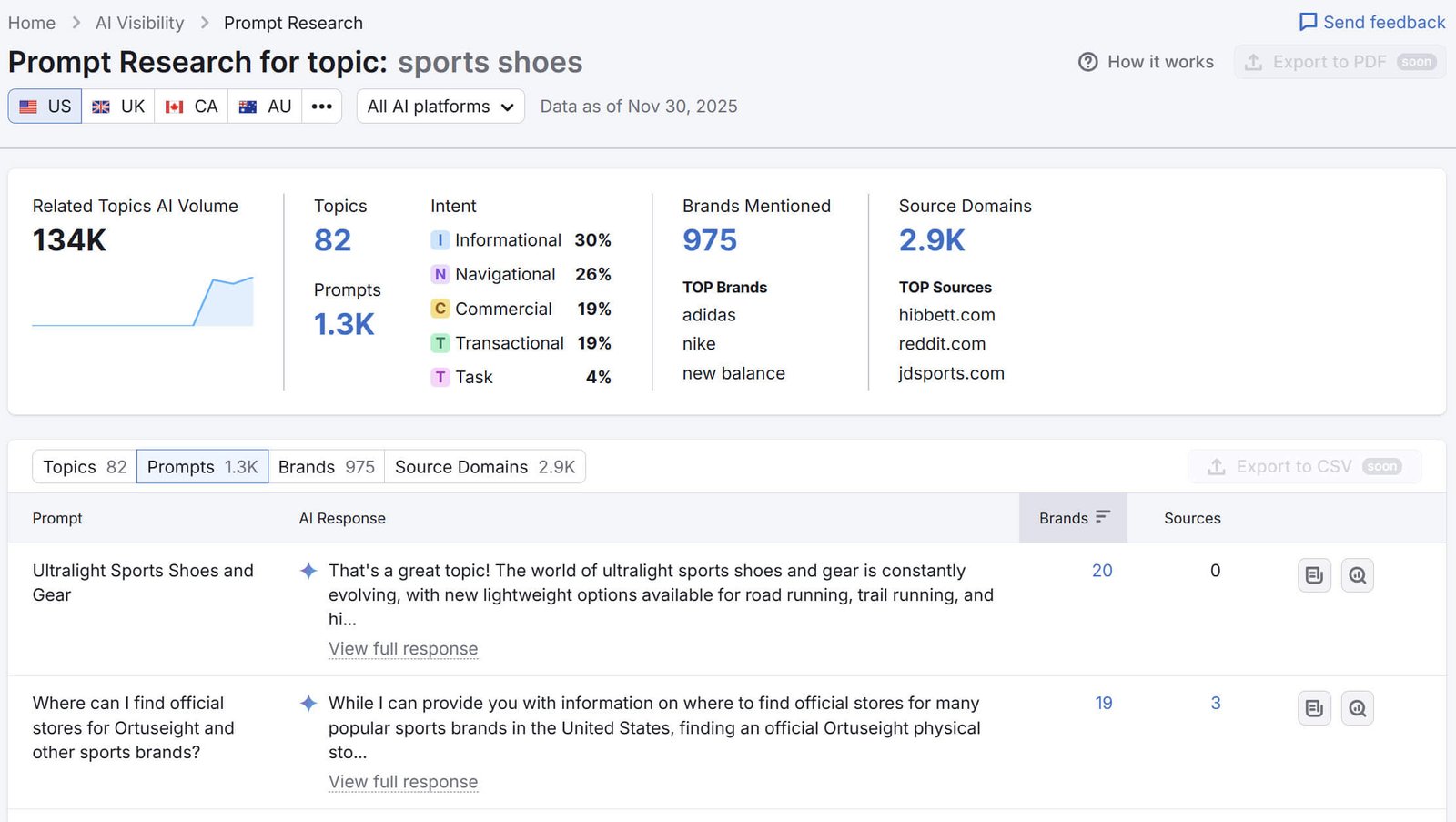
Semrush One is the only tool I’ve found that has this built in. Its Prompt Research feature works like keyword research, but for AI queries — it shows you the actual prompts people are using on generative AI platforms, along with volume data and which brands are getting cited in responses.
Here’s what it looks like in practice:
Want to try Semrush One for yourself?
What is AEO — Answer Engine Optimization
The core idea
AEO (Answer Engine Optimization) is the practice of optimizing your content to appear in direct-answer formats — Google’s featured snippets, People Also Ask boxes, knowledge panels, and voice search results.
The “answer engine” here is still mostly Google, but it’s a different version of Google than the one you’re targeting with traditional SEO. You’re no longer just trying to rank on a results page — you’re trying to be the single answer that appears above the results.
How it works in practice
AEO is about structure as much as content. Google extracts featured snippets by identifying content that clearly and concisely answers a specific question.
The techniques are straightforward once you know what you’re doing:
- Format answers as direct responses to question-based queries — lead with the answer, then expand
- Use FAQ sections with questions worded exactly as people search them
- Apply structured data markup (FAQ schema, How-To schema) so Google can read your content accurately
- Keep answer blocks tight — 40 to 60 words is the sweet spot for featured snippet extraction
- Use clear heading hierarchies so Google can map your content structure
AEO and GEO are more alike than different
Here’s something most comparison posts miss: AEO and GEO share a lot of DNA.
Structuring content for direct answers helps both. Clear question-and-answer formatting makes your content easier for Google to feature and easier for generative AI to extract and cite. You’re essentially optimizing for systems that want to give people a direct, useful response — whether that system is Google’s featured snippet algorithm or ChatGPT’s response generation.
Which means if you do AEO well, you’re also building your GEO foundation. They’re not in competition.
SEO, GEO, and AEO side by side
SEO — Optimize to rank in Google’s organic results. Target keywords, build authority, fix technical issues. Measured by rankings, impressions, and clicks.
GEO — Optimize to be cited or recommended by generative AI platforms (ChatGPT, Gemini, Perplexity). Build topical authority, create AI-extractable content, track brand mentions in AI responses. Measured by AI visibility and brand mention frequency.
AEO — Optimize for direct-answer formats in Google: featured snippets, PAA boxes, voice search. Structure content as concise Q&A, use schema markup. Measured by featured snippet ownership and PAA appearances.
How to optimize for all three without starting from scratch
Start with the content foundation — it serves all three
The most important thing to understand: one piece of well-built content can work for SEO, GEO, and AEO simultaneously.
A post that targets a keyword your buyers search (SEO), structures answers in clear Q&A format (AEO), and builds genuine topical authority in your category (GEO) is doing all three jobs at once. That’s the goal — not three separate content strategies, but one approach that’s been built with all three layers in mind.
The keyword research layer shifts for each
For SEO, you’re researching keywords people type into Google — volume, keyword difficulty, search intent.
For AEO, you’re specifically targeting question-format keywords: “how to,” “what is,” “why does.” These trigger featured snippet opportunities most reliably.
For GEO, the research shifts to prompts — the conversational queries people are asking AI platforms in your category. This is different data from traditional keyword research, and it requires a different tool to access it.
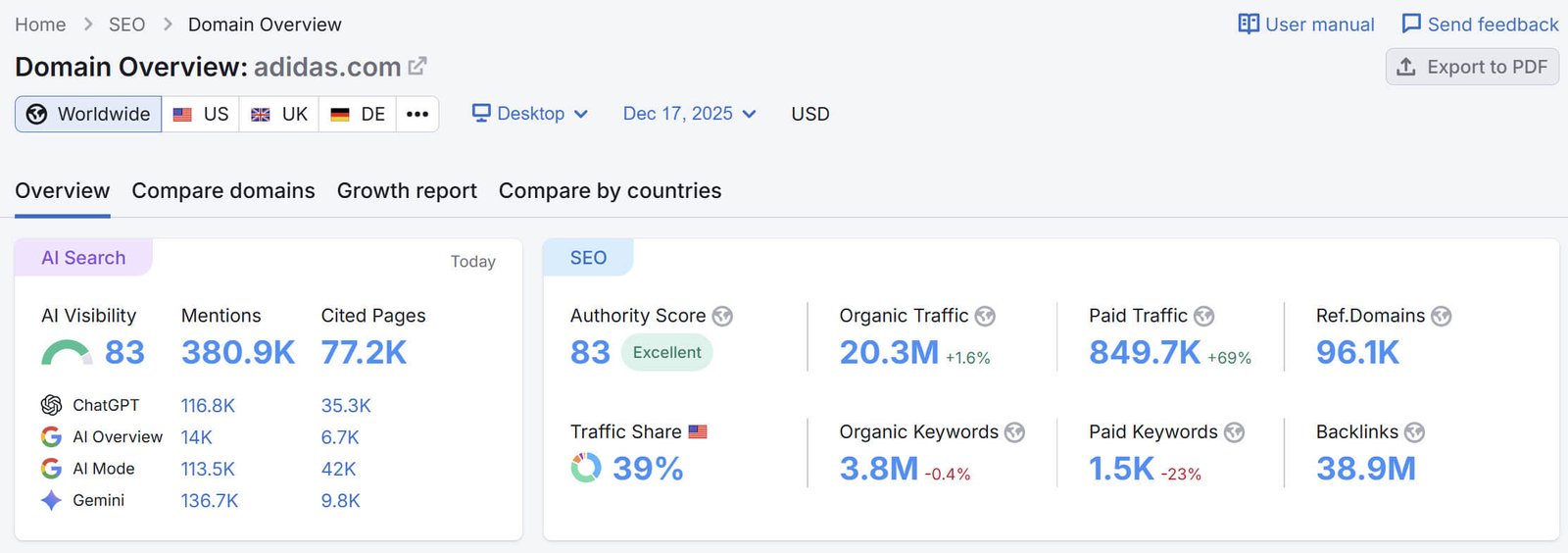
That’s where Semrush One Starter comes in. It’s the only tool I’ve found that gives you all three data layers in one place: keyword research and position tracking for SEO, On-Page SEO analysis for AEO optimization, and Prompt Research plus AI brand monitoring for GEO.
Measure each layer separately
You can’t improve what you don’t track — and each of the three requires different measurement.
- SEO: keyword rankings, organic traffic, impressions (Google Search Console + Semrush position tracking)
- AEO: featured snippet ownership, PAA appearances, structured data errors (Search Console + on-page SEO tools)
- GEO: brand mention frequency in AI responses, which prompts surface your competitors, AI visibility trend over time (Semrush One’s AI Visibility Toolkit)
Most businesses have decent SEO measurement in place. Almost none have GEO measurement running. That’s the gap — and it’s the reason the Semrush One AI visibility tools were the first thing I set up when I started taking GEO seriously.
The honest reality about where most businesses stand
When I work with service business owners on this, the pattern is almost always the same.
SEO is partially in place — some keyword work, inconsistent publishing, decent Google rankings for a handful of terms. AEO has usually happened accidentally rather than intentionally — some featured snippets picked up through good content, but no structured approach. GEO is almost always zero. No tracking, no prompt research, no idea whether competitors are being named in AI results.
That last gap is the one that’s most worth closing right now, specifically because the space is still open. KD scores across this entire keyword cluster are sitting at zero. Competition in AI search results hasn’t consolidated yet. The window to build GEO visibility before the space gets crowded is real — and it won’t stay open indefinitely.
Frequently Asked Questions
What is the difference between SEO and GEO?
SEO (Search Engine Optimization) focuses on ranking in Google’s organic search results through keywords, backlinks, and technical optimization. GEO (Generative Engine Optimization) focuses on being cited or recommended by AI platforms like ChatGPT, Gemini, and Perplexity. Both matter for visibility, but they target different systems and require different measurement approaches.
What is AEO in SEO?
AEO stands for Answer Engine Optimization — the practice of structuring content to appear in Google’s direct-answer formats: featured snippets, People Also Ask boxes, and voice search results. It uses techniques like FAQ schema, concise Q&A formatting, and clear heading hierarchies to help Google extract and surface your content as a direct answer.
Do I need to do SEO, GEO, and AEO separately?
No — and this is the most important thing to understand. One well-built piece of content can serve all three. The techniques overlap significantly: quality content, clear structure, and genuine topical authority support SEO, AEO, and GEO simultaneously. The main difference is in measurement and keyword research, where each layer requires slightly different data and tools.
Which tool covers SEO, GEO, and AEO in one place?
Semrush One Starter is the tool I use for all three. It includes traditional keyword research and position tracking for SEO, On-Page SEO analysis for AEO, and a dedicated AI Visibility Toolkit with Prompt Research and brand monitoring for GEO. It’s the only tool I’ve found that covers the full picture without needing to bolt on separate platforms.
Where to start
If you’re building this from scratch, the order matters.
Start with your GEO baseline — run a check on your AI visibility so you know where you stand before you start producing content. Then set up position tracking for your core SEO keywords. Then build your first content pieces with all three layers intentionally in mind: keyword-targeted, question-formatted, and structured for AI extraction.
That’s not a 90-day project. The setup takes a few hours. What takes time is the consistent content production — which is the same work you’re already doing, just done more deliberately.
You can start with a 14-day free trial and run your baseline checks before committing to anything.
👉 Start your free 14-day Semrush One trial — no credit card required →