The internet just shifted under your feet. Not because Google changed an algorithm, but because the way people find answers is changing entirely.
For 20 years, if you wanted to be found, you needed to rank on Google. That was the game. You optimized for keywords, built backlinks, and hoped Google’s algorithm would put you on page one. If it did, you won. If it didn’t, customers didn’t find you.
Now there’s a second game running parallel—and most service businesses don’t even know it exists. It’s called brand visibility in AI search.
When someone opens ChatGPT and asks a question, or uses Perplexity to research a solution, or Google’s AI Overviews, they’re not seeing the same results as a Google search. They’re seeing answers synthesized from across the web—and whether your business gets cited depends on something entirely different than search rank.
Here’s the thing: your brand might be nowhere in AI search. You could have top-10 Google rankings and still be invisible to AI-powered tools. That gap is expensive. It’s also fixable—but only if you know it’s there.
This post shows you what brand visibility in AI search actually is, why it matters for your business, and how to start tracking it right now.
What Is Brand Visibility in AI Search (And Why It’s Different From Google Rankings)
Brand visibility in AI search is whether your brand and content get cited when AI engines synthesize answers to questions in your industry. It’s measured across ChatGPT, Perplexity, Google AI Overviews, Claude, and other LLMs. Unlike Google ranking, which depends on link authority and keyword match, AI visibility depends on whether your content is structured clearly enough for AI to extract and cite.
You’ve spent years optimizing for Google. You know how it works: keywords matter, authority matters, link velocity matters. The algorithm rewards certain signals and punishes others. You understand the rules.
AI search engines work by a completely different logic.
When ChatGPT gets a question, it doesn’t rank websites—it synthesizes an answer from across its training data and sources. It pulls information from multiple places, stitches them together, and may or may not cite where that information came from. Your Google rank is irrelevant here. What matters is whether your content is structured clearly enough for the AI to pull and cite.
LLM Citations: The New Currency
An LLM citation is when an AI engine mentions your brand or links to your content as a source for its answer. This is different from a Google click. When someone gets an answer from ChatGPT that cites your business, they see your name, often a link, and credibility attached to that answer. If they click through, great. But even if they don’t, your brand just got positioned as an authoritative source on that topic.
This matters. A lot.
Answer Engine Optimization (AEO) Is Your New Front Door
Answer Engine Optimization (AEO) is the practice of structuring your content so AI engines can easily extract and cite it. Think of it as SEO’s cousin—same goal (get found), different mechanics.
In traditional SEO, you optimize for keyword relevance and authority signals. In AEO, you optimize for clarity. You write direct answers. You use schema markup. You structure FAQs so an LLM can parse them. You define your business entity so AI knows exactly who you are.
Here’s the real opportunity: most service businesses are doing neither well. They’re not optimizing for Google, and they’re certainly not optimizing for AI. That’s the 95% you’re leaving behind.
The shift is real: Traditional SEO gets you found by people searching Google. Brand visibility in AI search gets you found by people using AI as a research and decision-making tool. Both matter now. Most businesses are ignoring the second one.
Why Founders Don’t Track AI Visibility Yet
Most founders don’t track AI visibility because it’s new. Until 2024, there were no tools to measure it. Even now, most SEO platforms barely touch it. The awareness gap is real—and the opportunity cost is real with it.
Think about it: your competitors are still stuck optimizing for Google. That’s where they’re spending time and money. But the smartest ones—the ones who are already at Level 5 and above in the AI maturity ladder—are asking a different question: “What happens when buyers stop searching Google and start asking AI?”
That question changes everything.
Right now, in early 2025, there’s a gap. Most search professionals haven’t caught up. Most service business founders certainly haven’t. The playbooks for AI visibility are still being written. Tools for measuring it are brand new. Strategies for optimizing for it are still experimental.
That’s an advantage if you move now. In 18 months, when this is mainstream, everyone will be doing it. But today? You can build visibility in AI search while competitors are still obsessing over page-one Google rankings.
The Real Cost of Invisibility in AI Search
What are competitors who ARE tracking AI visibility building right now? They’re restructuring content. They’re defining their brand entities more clearly. They’re getting cited in AI-generated answers. They’re positioning themselves as go-to sources before the rest of the market wakes up.
Meanwhile, you’re invisible. Not because you’re not good at what you do. But because AI engines can’t easily find and cite your work.
How Semrush One Reveals Your Brand Visibility in AI Search
Semrush One is one of the first tools to systematically measure brand visibility in AI search. It shows you which AI engines cite your competitors, what questions your brand appears in, and how your brand is perceived across ChatGPT, Perplexity, and Google AI Overviews.
Measuring something is the first step to improving it. You can’t fix what you can’t see.
That’s why the new AI Search tab in Semrush One matters. It’s a measuring instrument for your AI visibility. Here’s what it shows:
1. Domain Overview with AI Search Tab: Who’s Citing You
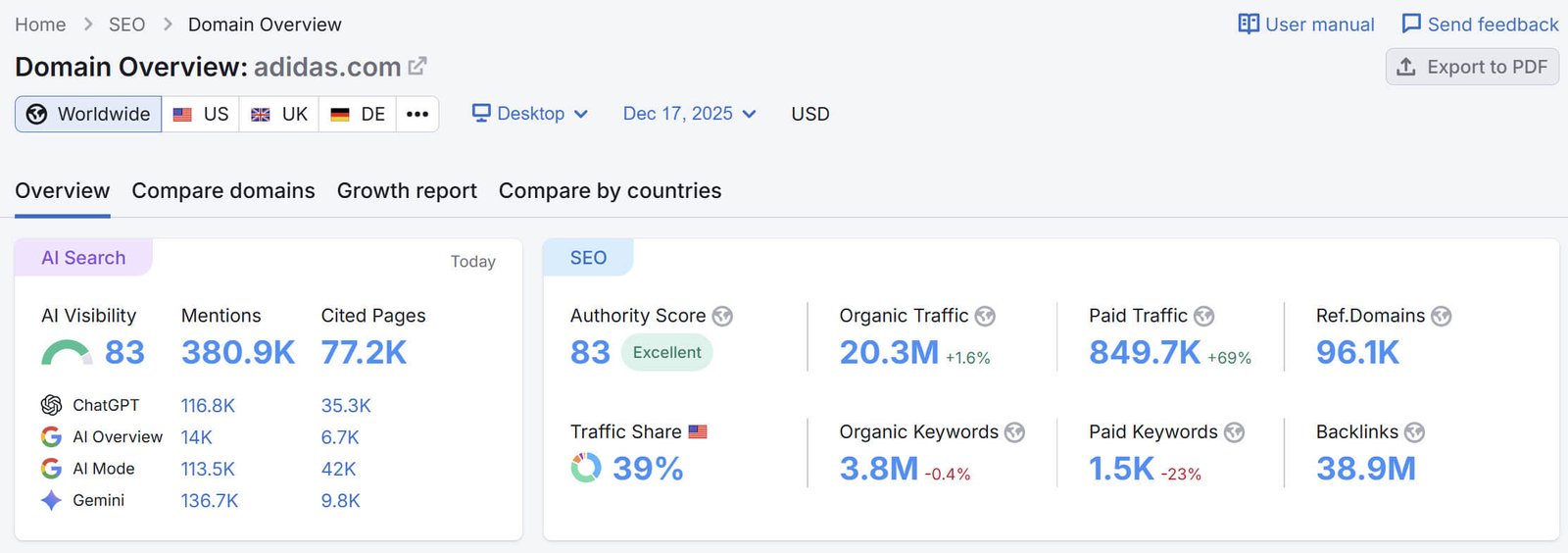
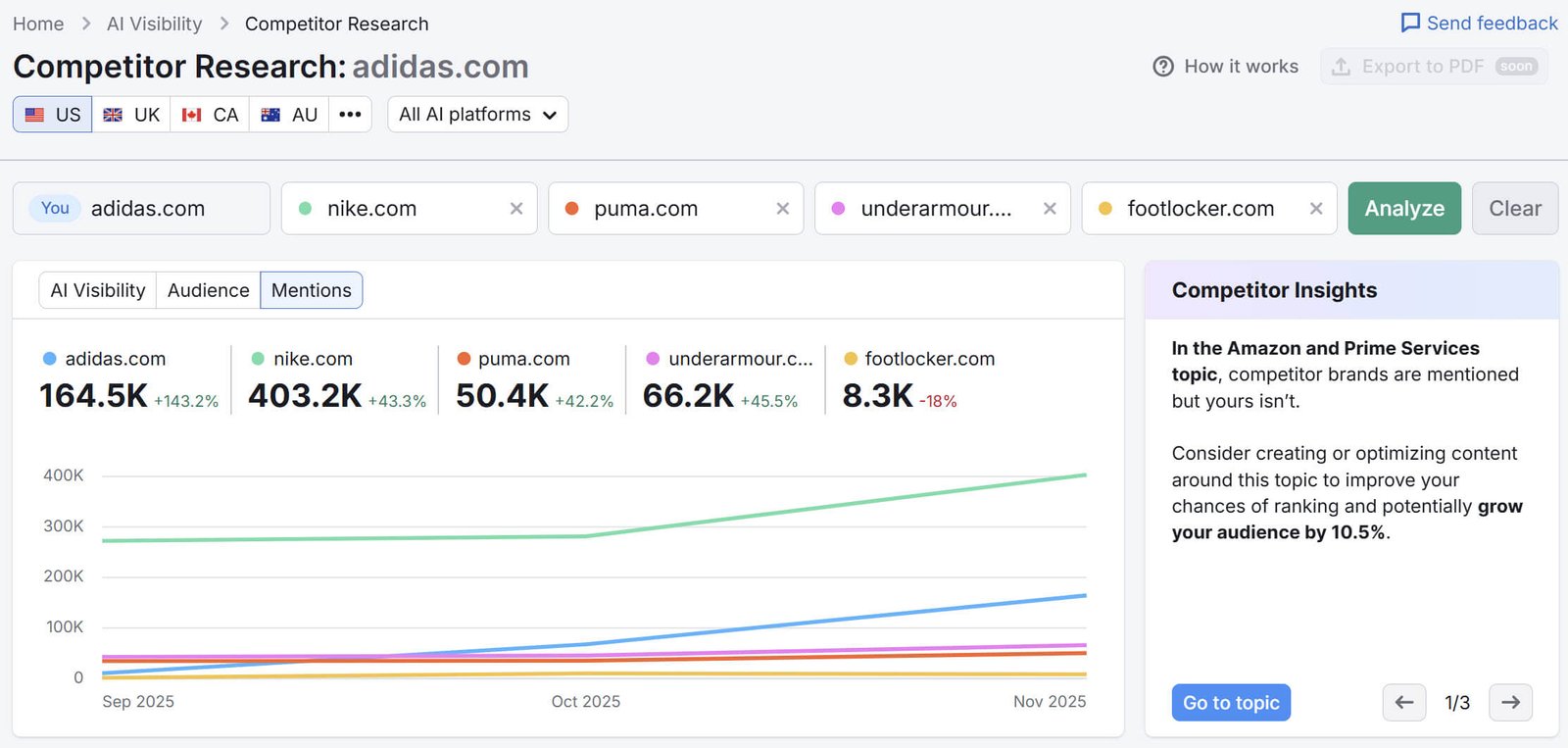
The Domain Overview shows how often your brand gets cited across AI engines. You can see which competitors are getting cited more often than you, which AI engines cite you most, and which topics trigger your citations.
This is your baseline. You can’t improve visibility without knowing where you stand.
2. Topics & Prompts: What Questions Should You Be In
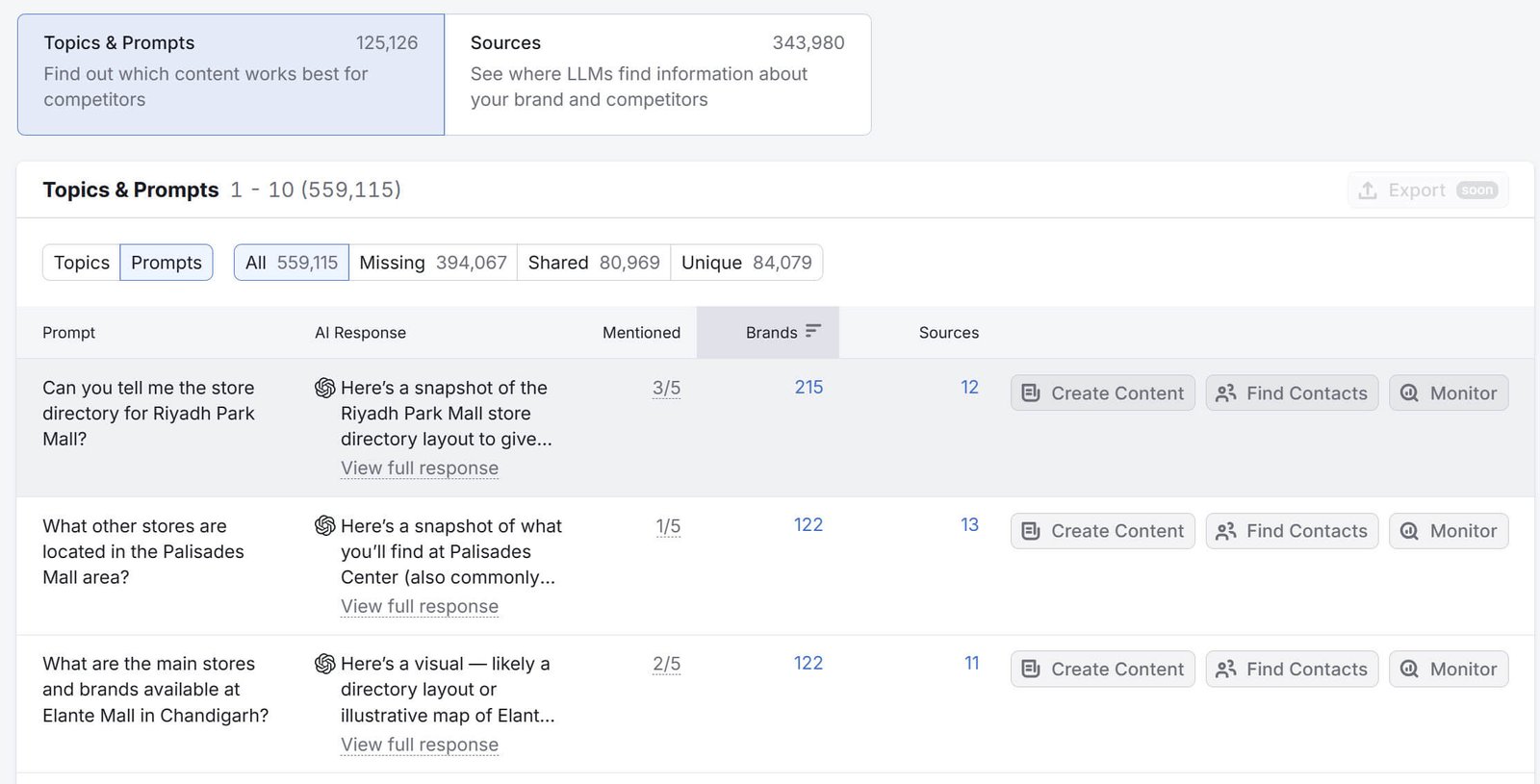
Semrush One maps the questions being asked in your industry and tracks which brands get cited for answers. You discover prompts like “How should I choose a service provider?” or “What questions should I ask before hiring?” and see which competitors are getting cited when AI answers them.
This tells you where the visibility gaps are. You might rank well for keyword-based searches but be completely absent from the AI-powered conversation around those same topics.
3. Brand Performance: How You’re Perceived Across AI
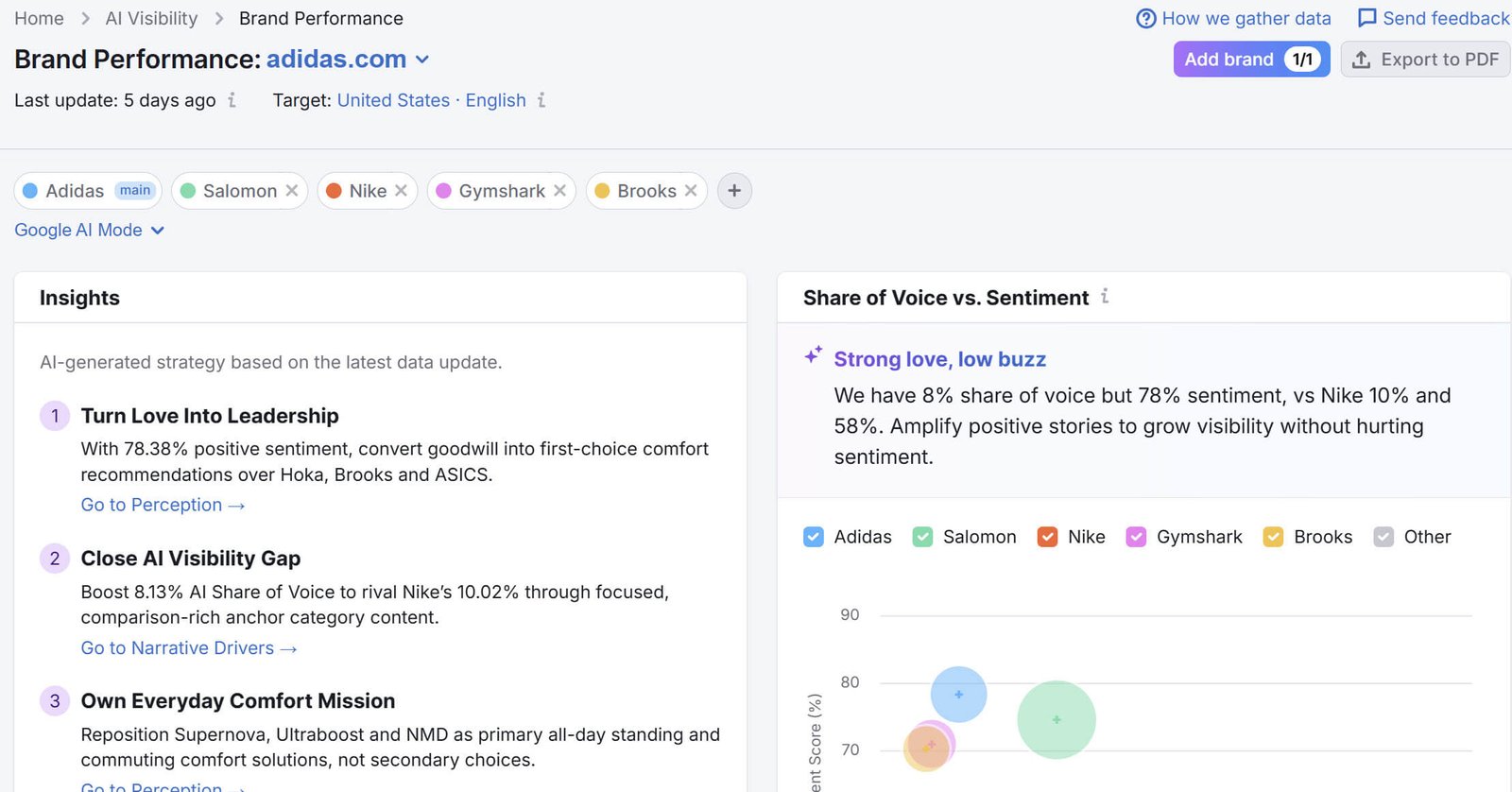
This dashboard shows your visibility trends over time. Are you getting MORE citations or fewer? Which AI engines mention you most? How does your citation volume compare to direct competitors?
You can explore the full toolkit with a 14-day Semrush Pro trial. That gives you full access to start measuring your AI visibility right now.
The Three AI Visibility Gaps Most Service Businesses Have
Most service businesses have three core gaps in AI visibility: unstructured content that’s hard for AI to extract, unclear brand entity definition, and no monitoring system. These gaps are fixable—but you need to see them first.
Gap 1: No Structured Content for AI Extraction
Your content exists, but it’s written for humans reading a web page. An AI engine trying to extract a clear answer hits walls: paragraphs are long, answers are buried in stories, there’s no schema markup that says “this is an answer to a question,” and the information is scattered across multiple pages.
AI needs clarity. It needs direct answers. It needs FAQs structured with schema. It needs headers that clearly map to questions. When that structure doesn’t exist, even great content gets overlooked.
Gap 2: No Entity Definition
AI engines don’t just see your website. They try to build a profile of your business: who you are, what you do, what you’re known for, who endorses you, what people say about you. If that information is scattered, contradictory, or missing, AI doesn’t “know” you well enough to recommend you.
You might have an About page, a LinkedIn profile, some industry mentions, and a few case studies spread across your site. But if those don’t paint a unified picture of who you are, AI struggles to build confidence in citing you.
Gap 3: No Monitoring
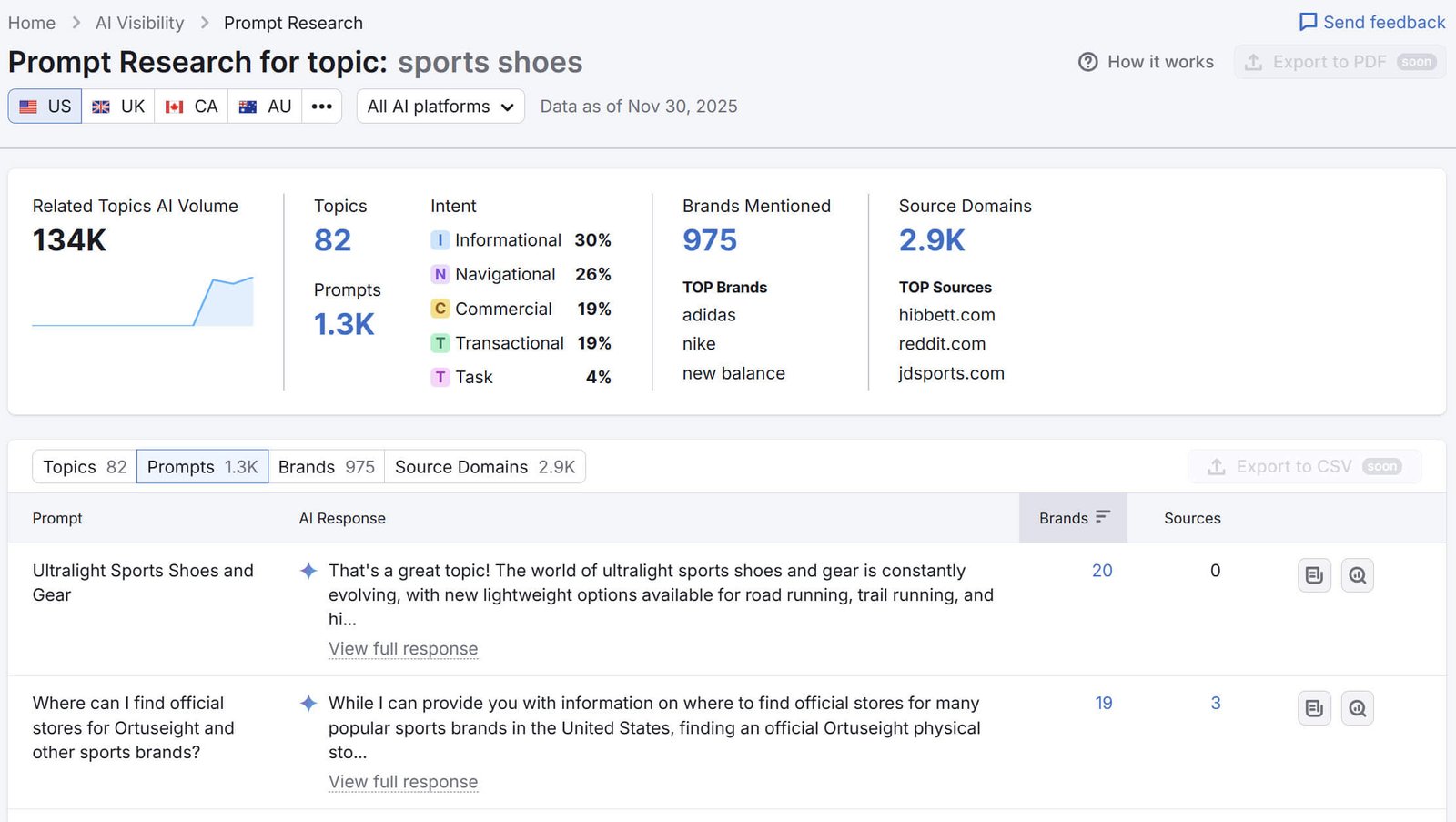
You can’t improve what you can’t measure. Most service businesses have zero visibility into their AI search performance. You’re not tracking citations. You’re not watching which questions your brand shows up for. You’re not comparing yourself to competitors in AI search.
You’re flying blind—and your competitors might not be.
The common pattern: You’ve optimized your site for Google. You’re ranking for your keywords. But when someone asks ChatGPT or Perplexity the same questions, your name doesn’t come up. That’s gap 3 in action.
How to Act on Your AI Visibility Data
Once you see your AI visibility gaps, action is straightforward: fix content structure, strengthen your brand entity, and set up monitoring. These changes compound—each one makes you more visible across AI engines.
Data without action is just numbers. Here’s how to move from measurement to improvement:
Step 1: Fix Your Content Structure
Start with the content that gets the most potential citations—usually your homepage, service pages, and core educational content. Rewrite these with AI extraction in mind:
- Begin with a direct answer (1-2 sentences) to the main question your page addresses
- Use clear H3 headers that map to common questions in your industry
- Add FAQ sections with direct Q&A pairs (use schema markup if your CMS supports it)
- Break long paragraphs—aim for 2-3 sentences max
- Link to your own authoritative pages to help AI understand your expertise
This isn’t rewriting your entire site overnight. It’s strategic refinement of your highest-value pages first.
Step 2: Strengthen Your Brand Entity
Go through your core brand touchpoints and make sure they all tell the same story:
- Your website About page: Who you are, what you do, how long you’ve been doing it
- Your LinkedIn profile: Same core narrative, optimized for discoverability
- Google Business Profile: Complete, accurate, consistently updated
- Industry mentions: Where you’re mentioned, how you’re described
- Case studies or testimonials: Real examples of the work you do and results you deliver
When these pieces align, AI engines build a coherent understanding of your business. That coherence triggers citations.
Step 3: Set Up Monitoring
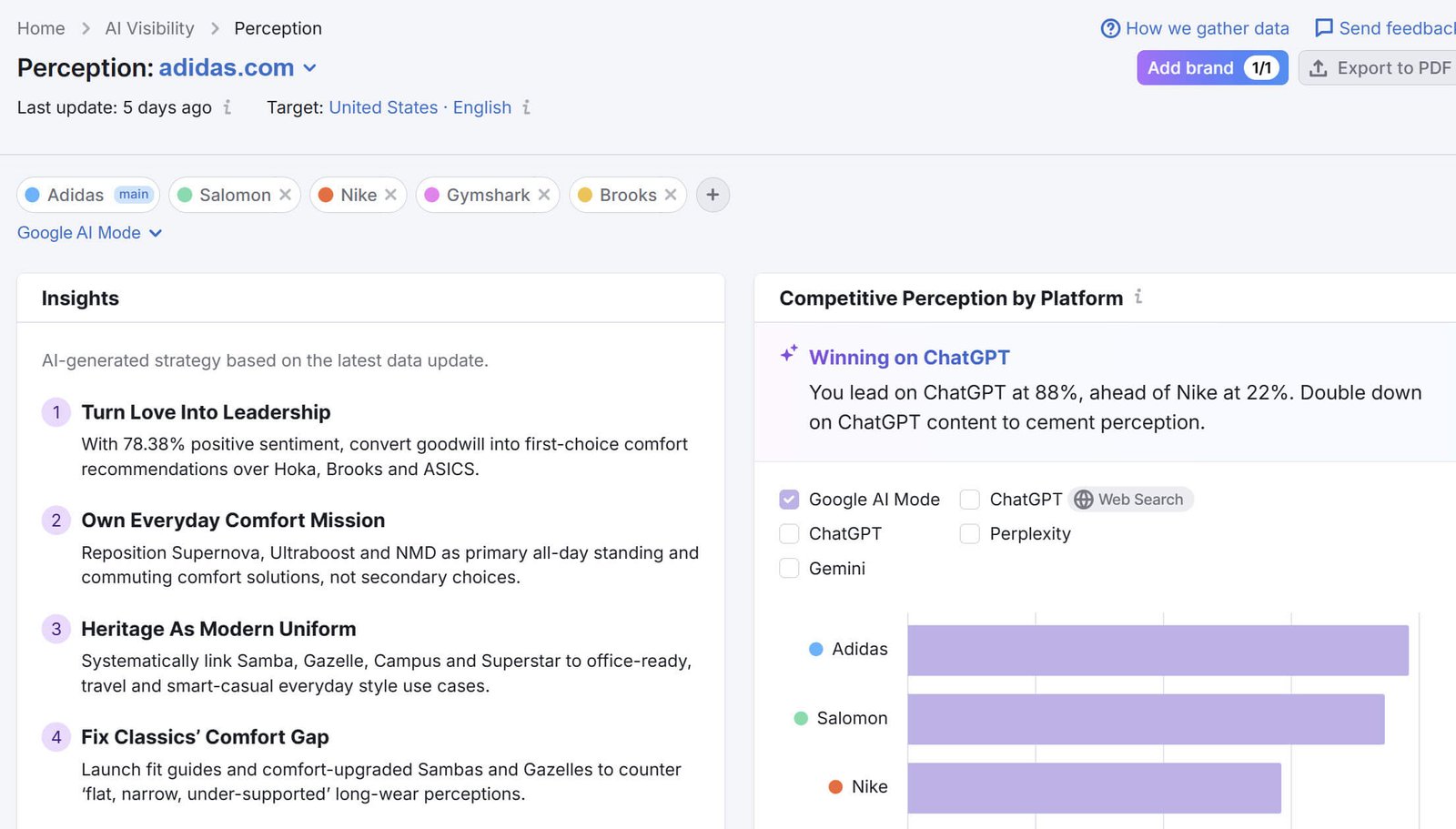
Use Semrush One’s Brand Performance tracking to watch your AI visibility over time. Set it up once and let it run. You’ll see:
- Citation frequency trends (are you getting cited more or less month-to-month?)
- Which AI engines cite you most
- Which topics trigger your citations
- How your visibility compares to competitors
Monitoring turns a one-time audit into an ongoing system. You can access this with a 30-day Semrush Guru trial if you want to go deeper into competitive analysis alongside your own tracking.
The Big Picture: From AI as Google to AI as Infrastructure
These three actions—fix structure, strengthen entity, monitor performance—are entry-level moves into building an AI visibility strategy. But they’re also a shift in how you think about your business’s visibility online.
Most founders treat AI like a tool. “I’ll use ChatGPT to write my emails.” That’s Level 1. But building an AI SEO strategy that treats AI visibility as a core part of your growth system? That’s Level 5 thinking. Your content doesn’t just show up in Google search. It gets recommended by AI. Your brand doesn’t just rank—it gets cited as authoritative. Your business starts to exist in the AI-powered conversation around what you do.
That’s the real opportunity.
FAQ
How does brand visibility in AI search work?
AI engines read your content and training data to synthesize answers to questions. If your content is structured clearly, you’re relevant to the question, and your brand is well-defined, the AI engine cites your work as a source. Unlike Google ranking, which depends on authority and links, AI citations depend on clarity and relevance. You optimize for how AI reads, not how Google’s algorithm scores.
Is brand visibility in AI search the same as SEO?
No, they’re related but different. SEO optimizes for keyword ranking and authority signals—what makes Google rank you higher. AI visibility optimizes for citation potential—what makes LLMs cite you as a source. You can rank well for keywords and still be invisible in AI search, or vice versa. The best strategy handles both.
What tools measure brand visibility in AI search?
Semrush One is the most comprehensive option right now. It specifically tracks citations across ChatGPT, Perplexity, and Google AI Overviews. Other SEO platforms are starting to add AI search metrics, but Semrush One leads on depth and accuracy.
How long does it take to appear in AI search results?
AI engines continuously update their training data and sources, so the timeline isn’t as rigid as Google’s indexing. Structural improvements (better headers, schema markup) can show results in weeks. Brand entity strengthening takes longer—usually 2-3 months of consistent mentions and citations. Monitoring helps you see when progress happens.
Why is my brand not mentioned in AI search answers?
Usually three reasons: your content isn’t structured clearly (AI can’t extract answers easily), your brand entity is weak (AI doesn’t recognize you as authoritative), or you’re not relevant to the questions being asked. Start with measurement (Semrush One shows you exactly which of these is your bottleneck), then fix the top issue first.
The Opportunity In Front of You
Google’s dominance in search isn’t ending. But it’s shifting. The next generation of discovery runs through AI. People are asking ChatGPT, Perplexity, and Claude instead of typing into a search bar. When they do, they’re looking for recommendations, not just links.
Your brand visibility in AI search determines whether you get recommended or overlooked in that new world.
Most service businesses—8-20 person teams running operations the way they did five years ago—are still at Level 1 or 2. They use AI like Google. They ask ChatGPT questions and get answers. But they don’t think about what happens when their customers ask AI the same questions. They don’t measure whether they show up. They don’t optimize to be cited.
That’s the gap. And it’s where the real growth is.
If you want to understand where your business sits in the AI landscape—and which systems to build first—grab the free BrandAI Growth Systems Blueprint. It walks you through the full picture of what’s possible, from Level 1 (where you are now) to Level 8 (where the real competitive advantage lives).
And if you’re ready to see your AI visibility data right now, the 14-day Semrush Pro trial gives you full access to start. You can see exactly where your brand shows up in AI search, which questions you’re missing, and what your competitors are already doing about it.
The shift is happening. The question is whether you’re going to be visible in it.