Most business owners have been told the same thing: publish more content. Write more. Post more. Stay consistent.
Here’s the thing — volume without a strategy is a hamster wheel.
You write, you publish, and six months later you wonder why the traffic never came. The problem is not your writing. The problem is you’re treating SEO like a content factory when it’s actually a research problem.
An AI SEO strategy changes that. It gives you a repeatable system for:
- Finding the right topics worth targeting
- Producing content with a real point of view
- Building visibility across both traditional search engines and AI platforms — ChatGPT, Perplexity, Google AI Overviews
This guide walks through the five-step system I use in my own business and help service business founders build for theirs.
By the end, you’ll know exactly what to do, in what order, and which tools make the process run with far less effort than doing it manually.
What an AI SEO Strategy Actually Means (And What It Doesn’t)
An AI SEO strategy is not “use ChatGPT to write your blog posts.”
That’s Level 1 thinking — using AI as a system vs. using it as a search bar. One is a shortcut; the other is infrastructure.
What a Real AI SEO Strategy Combines
A real AI SEO strategy brings together three things:
- AI tools to find keywords worth targeting
- A structured process for producing content that adds your perspective
- A tracking system that monitors performance across both traditional search and AI-powered search engines
The Two Meanings of “AI” in AI SEO
First — you’re using AI tools to do the research, drafting, and optimization work faster.
Second — you’re now optimizing for AI search engines as well as Google. Your clients are increasingly getting answers from ChatGPT and Perplexity, not just Google’s blue links.
That second part is what most business owners miss entirely. If your content only optimizes for traditional search, you’re building for yesterday’s search landscape.
Step 1 — Use AI to Find Keywords Worth Targeting (for SEO AND AI Search)
Keyword research is where most content strategies fall apart.
People pick topics they think are interesting, write the post, then wonder why it never ranks. The real question is: what are the people you want to reach actually searching for — and where are they searching?
The Search Landscape Has Changed
A few years ago, “where are they searching” had one answer: Google.
Now it’s Google, ChatGPT, Perplexity, Google AI Overviews, and Gemini. Each of those pulls from different data sets and cites different sources.
If your content shows up in Google but not in any AI search result, you’re invisible to a growing portion of the market.
Why I Use Semrush One for Keyword Research
This is why I use Semrush One for keyword research.
It’s the only toolkit I’ve found that covers both traditional SEO and AI search visibility in one place — so you’re not stitching together three different tools to get a complete picture.
Here’s what that looks like in practice:
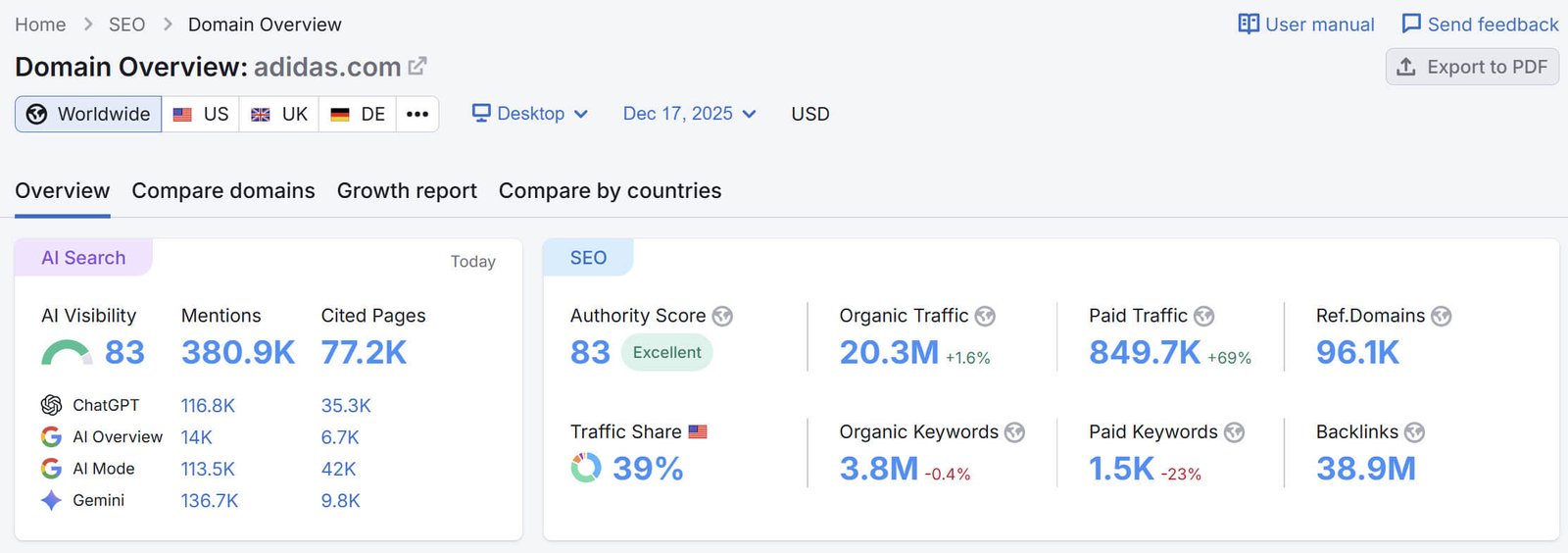
The Domain Overview shows your traditional SEO data alongside your AI search visibility:
- Organic traffic and keyword rankings
- How your brand appears across ChatGPT, Google AI Overviews, Perplexity, and Gemini
- One combined view instead of switching between tools
For a service business founder, that combined view is what you actually need. You’re not managing an enterprise content operation — you need to know where you stand and what to do next.
The AI Visibility Toolkit
The AI Visibility Toolkit inside Semrush One goes further:

What you can do with it:
- Track how your brand appears across AI platforms
- Compare your visibility against up to four competitors
- See the actual prompts people submit to AI search engines in your industry
Semrush One draws from a database of over 100 million tracked AI prompts — including 29 million ChatGPT-specific searches — so you’re working with real data, not guesses.
Topics and Prompts: Your Content Gap Map
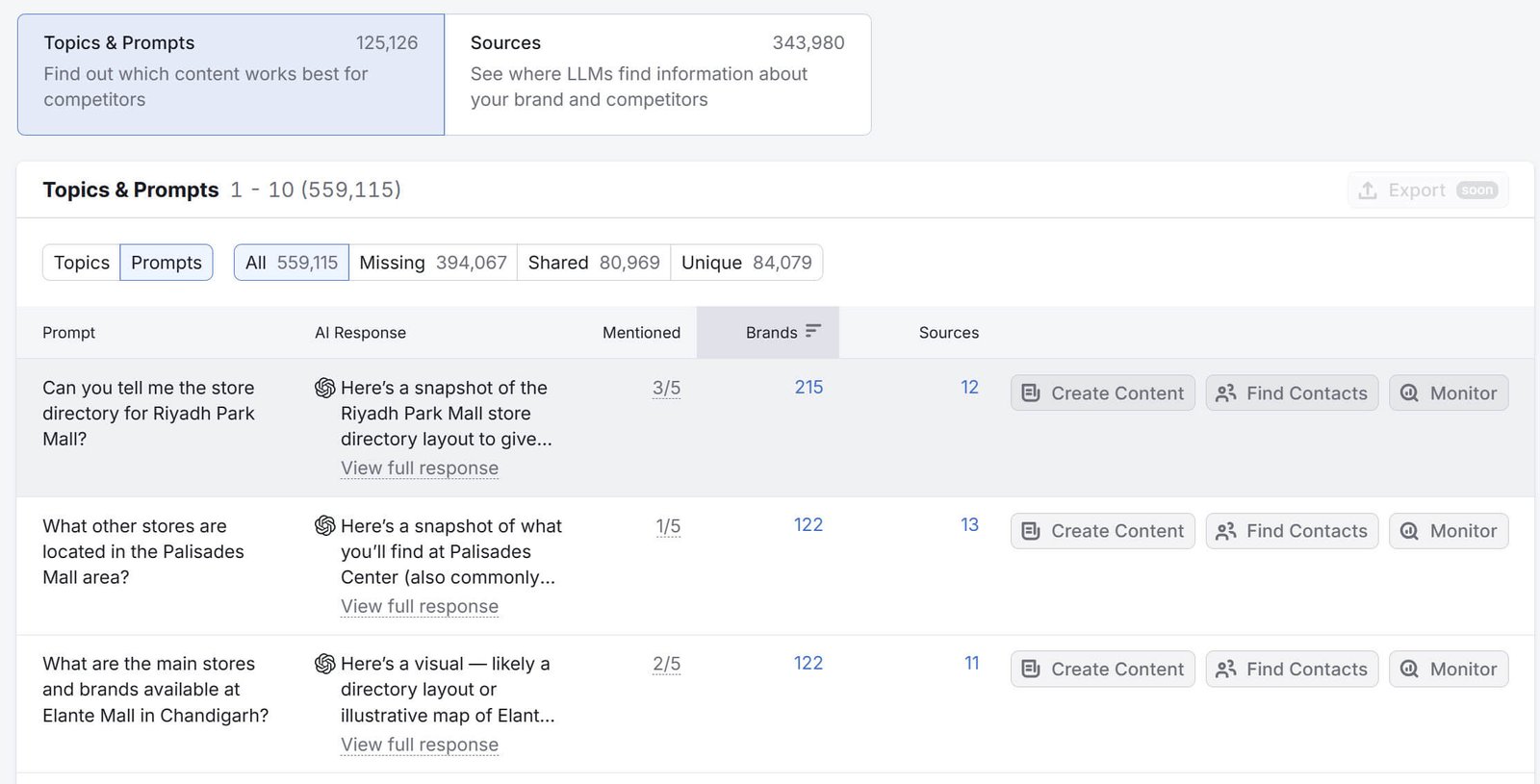
The Topics and Prompts view shows you:
- The exact questions people ask AI engines about your space
- Which topics get cited most
- Where your competitors are being mentioned instead of you
That’s your content gap map right there.
Traditional SEO + AI Search in One Toolkit
For traditional SEO keyword research, the Semrush Keyword Research toolkit covers volume, keyword difficulty, CPC, and trend data across a database of 27.3 billion keywords.
The AI Search Health Meter also scans for technical crawlability issues that could prevent AI search engines from indexing your content.

If you’re running an active content program, Semrush One is the most direct way to get visibility across both search environments.
See the full breakdown of what’s included in my Semrush One review, and there’s a 14-day free trial if you want to test it before committing.
Step 2 — Build a Content Brief Before You Write a Word
This is the step most people skip.
They do the keyword research, open a blank doc, and start writing. The result is a post that covers the topic loosely without a clear structure — and loosely structured content does not rank.
What Goes in a Content Brief
A content brief is the architecture of your post before a single paragraph gets written. It specifies:
- Your primary keyword and secondary terms
- The search intent behind the query
- The heading structure (H1, H2s, H3s)
- The sources you’ll cite
- The questions your audience is actually asking
How I Build a Brief
I pull the top-ranking pages for my target keyword and look at what they cover — and more importantly, what they miss.
That gap is where the opportunity is.
An SEO content brief that maps out those gaps before you start writing is the difference between content that ranks and content that disappears.
Intent Shapes Everything
The brief also forces you to think about intent.
Someone searching “AI SEO strategy” is probably not ready to buy anything yet — they want to understand what the strategy involves. That shapes the tone, the depth of explanation, and the call to action you use at the end.
Brief first, write second. Always.
If you want a framework for building the brief itself, this guide on crafting SEO-friendly content outlines walks through the structural decisions in detail.
Step 3 — Produce Content That Adds Your Perspective
Here’s the opinion I hold about AI-assisted content: the problem is not that AI is involved. The problem is when AI writes the whole thing and nobody adds a point of view.
Google and AI search engines are both getting better at identifying generic, interchangeable content. What they reward is specificity, original thinking, and demonstrated expertise.
This Is What Actually Works
Use AI to do the structural and research-heavy work, then add your own experience, opinion, and examples.
The post I’m writing right now follows that approach. I know what tools I use. I know what my clients experience. I know what the research shows. AI helps me structure that efficiently — it does not replace the substance.
The Accessible Starting Point: Semrush Content Tools
For most service businesses, Semrush’s Content Toolkit and ContentShake are accessible ways to produce AI-assisted content that’s already informed by keyword data.
ContentShake generates article drafts based on your target keyword and top-ranking competitor content — a solid starting point that you then shape with your voice and experience.
The Advanced System I Use
For my own business, I built something more advanced: a custom SEO agent team running in Claude Code that connects directly to Semrush for keyword research and insights, applies my brand voice rules at every step, and produces WordPress-ready HTML.
I needed consistent, on-brand content without spending hours per week on writing. The system now runs with minimal input and produces content that performs. That’s the advanced end of the spectrum — and it’s covered in detail if you want to see the full AI writing workflow step by step.
The Semrush tools are the right starting point for most businesses. The custom agent system is what you build when you’re ready to treat content production as a core operational function.
Step 4 — Build the System So It Runs (With Human Supervision)
An AI SEO strategy is only as good as the system behind it.
One post is a piece of content. A consistent publishing cadence built on research and process is a visibility asset.
What the System Handles vs. What You Handle
The goal is to build a system that handles the heavy lifting:
- Keyword research
- Brief creation
- Drafting
- Optimization
So the human work is focused on reviewing, adding expertise, and publishing.
You still need a human in the loop. AI does not know your clients the way you do, and it cannot replace the judgment call you make about what’s worth publishing.
A Working Weekly Content Cycle
- Week 1: Keyword research and topic selection — identify 4 posts for the month based on keyword data and search intent
- Week 2: Brief creation — build structured outlines for all 4 posts, map sources and internal links
- Week 3: Drafting and first review — AI produces drafts, human reviews and adds perspective, stories, and opinion
- Week 4: Optimize, finalize, and publish — run optimization checks, schedule posts, repurpose for other channels
That four-week cycle means you’re always one month ahead. Topics chosen, briefs built, drafts in review. No scrambling to produce something at the last minute.
One Person With a System Beats a Team Without One
I work with founders who think they need a content system instead of a team. Once the system is in place, one person overseeing it produces more consistent output than a team doing it manually.
And once you’ve produced a set of posts, there’s significant additional reach in turning one piece into five — the same source content reformatted for LinkedIn, email, and short-form video without starting from scratch.
Step 5 — Optimize Each Article for SEO and AEO Before Publishing
Most business owners think SEO optimization means putting the keyword in the title.
That’s step one, not the whole job. And if you want to show up in AI search results, there’s an additional layer of optimization that most content skips entirely.
Traditional SEO Checklist
- Primary keyword in the H1 title, in the first 100 words, and in 2-3 H2 headings
- Meta title under 60 characters with the keyword in the first three words
- Meta description under 155 characters with keyword, benefit, and a reason to click
- URL slug: keyword-first, hyphens, no stop words
- Image alt text: keyword in at least one image alt attribute
- Internal links: 3-5 links to relevant pages on your site with descriptive anchor text
- Clean heading hierarchy: single H1, logical H2s and H3s, no skipped levels
AEO (Answer Engine Optimization) Checklist
This is the part most content programs miss:
- Answer blocks at the start of key sections — a direct 40-60 word answer to what the heading asks, written to be extracted by AI systems
- FAQ section with direct answers — the answer comes before any explanation, so AI search engines can pull it as a clean citation
- Schema markup: Article schema, FAQ schema, and HowTo schema where relevant — structured data is how you signal to AI systems what your content covers
- Authoritative sourcing: cite credible external sources to establish the content’s trust signals
Pre-Publish Scoring
The Semrush SEO Writing Assistant runs an automated score against your target keyword and gives you specific recommendations before you publish:
- Readability score
- Keyword usage
- Originality check
- Tone of voice
It takes five minutes and catches things that are easy to miss.
Why Schema Markup Matters
FAQ schema tells Google and AI search engines that your content contains question-and-answer pairs — which increases the chance of being pulled as a source in AI-generated answers.
HowTo schema signals a step-by-step process.
Article schema confirms the author, publication date, and publisher — all trust signals that AI systems use to evaluate whether your content is worth citing.
This last step is where most content programs leave points on the table. The content gets written and published, but the structured data and optimization layer never happens. That optimization is what separates content that shows up from content that just exists.
Frequently Asked Questions
What is an AI SEO strategy?
An AI SEO strategy uses AI tools to handle keyword research, content brief creation, drafting, and optimization — and extends traditional SEO to also target AI search engines like ChatGPT, Perplexity, and Google AI Overviews.
The goal is a repeatable content system that produces consistent search visibility without requiring manual effort at every step.
Can AI really improve my SEO rankings?
Yes, when used correctly. AI tools speed up keyword research, help structure content around what performs, and assist with optimization checks before publishing.
The key is that AI handles the structural and research work while you add the perspective and expertise. Generic AI-only content produces generic results.
What AI tools are best for SEO content?
For a service business, Semrush One covers keyword research, AI visibility tracking, content optimization, and competitor analysis in one toolkit.
ContentShake assists with AI-assisted drafting, and the SEO Writing Assistant scores your content before publishing. These three cover most of the pipeline.
How do I get my content to show up in AI search results (ChatGPT, Perplexity)?
- Add FAQ schema and HowTo schema markup
- Write direct answer blocks at the start of key sections (40-60 words answering the heading question directly)
- Cite credible external sources
- Ensure your site is technically crawlable
Semrush One’s AI Search Health Meter scans for crawlability issues that could prevent AI engines from indexing your content.
Is SEO still worth investing in with AI changing search?
Yes — and the argument for investing is actually stronger now.
AI search engines pull from indexed web content. If your content is not indexed, authoritative, and well-structured, you cannot appear in AI-generated answers.
The businesses building SEO infrastructure now are the ones that will have visibility in both traditional and AI search over the next three to five years.
How long does it take to see results from an AI content strategy?
For a new domain or low-authority site, plan for three to six months before significant organic traffic builds.
The system starts working faster when you target lower-competition keywords (under KD 30) and publish consistently.
AI visibility in platforms like ChatGPT and Perplexity can build faster than traditional SEO rankings, since those systems update their source databases more frequently than Google’s index cycles.
The Five-Step System, Summarised
An AI SEO strategy is not a content hack. It’s a research-and-production system that finds what your audience is searching for, structures content to answer it well, and tracks visibility across search environments that now include AI platforms.
The five steps:
- Use AI tools to find keywords for both traditional SEO and AI search
- Build a proper content brief before writing
- Produce content that adds a real point of view
- Build the production system with human supervision in the loop
- Optimize for both SEO and AEO before every publish
If you want to see what a full AI-powered business system looks like — including this Visibility and Content System and the five other systems that run alongside it — the BrandAI Growth Systems Blueprint walks through the complete picture with practical steps for getting started.
It’s free, and it gives you the full view before you touch a single tool. Get the Blueprint here.
If you’d rather talk through what this looks like for your specific business, the Growth Systems Audit gives you a score and a plan. And if you want to move fast, the Power Hour is a focused session to map out exactly which systems to build and in what order.
Start with the Blueprint. See the full picture first.