Search visibility used to mean Google rankings. Track your keywords, climb the results, watch traffic grow.
But here’s what changed:
- 77% of Americans now use ChatGPT as a search engine.
- 24% choose it before Google.
- AI traffic grew 7 times from 2024 to 2025.
- ChatGPT alone drives 77% of all AI search traffic.
The problem? You could rank #1 on Google but be completely invisible when people ask ChatGPT or Perplexity for recommendations in your industry.
You need a tool that tracks both channels separately – because your Google performance and AI visibility are often completely different. That’s where Semrush One comes in.
What Is Semrush One?
Semrush One is a bundle that combines traditional SEO tools with brand-new AI Visibility tracking, released in October 2024.
Here’s the key difference from classic Semrush:
- Classic Semrush = SEO tools only
- Semrush One = SEO tools + AI visibility tracking in a unified dashboard
The core idea is simple: track both Google rankings AND AI platform mentions in one place, with separate views so you can see exactly how each channel performs.
Why does this matter? Because your Google strategy and AI visibility strategy may need to be different. You might need to create different content, target different topics, or emphasize different aspects of your expertise depending on which channel you’re optimizing for.
Semrush One is available in three pricing tiers, and it’s currently the only major platform offering this unified SEO + AI visibility approach.
The AI Visibility Toolkit: The Main Event
This is the new part – the reason Semrush One exists.
Let’s break down what “AI Visibility” actually means: how often and how favorably your brand gets mentioned when people use AI search platforms like ChatGPT, Perplexity, Google AI Overviews, and Gemini.
This section comes first because it’s what makes Semrush One different from every other SEO tool.
The SEO toolkit is solid (we’ll cover it next), but you can get SEO tools elsewhere. AI visibility tracking is what’s new and unique.
1. AI Visibility Overview Dashboard
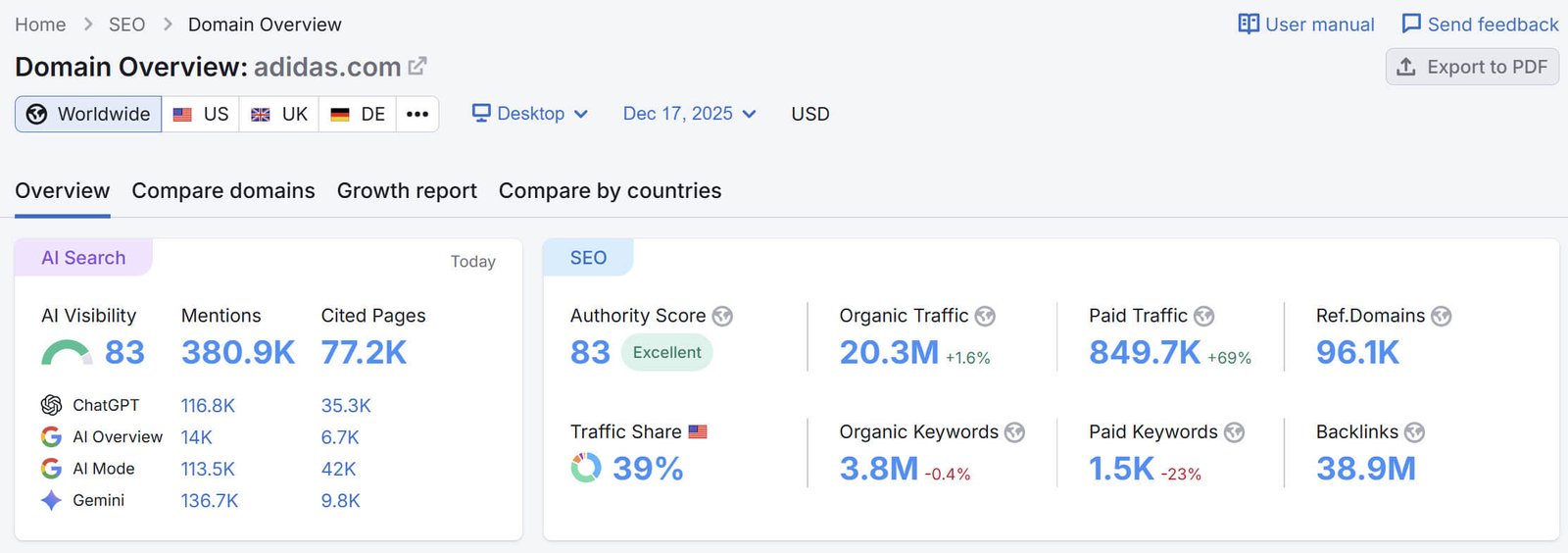
Your overall presence score across AI platforms compared to competitors in your industry.
The dashboard displays metrics like total mentions, cited pages, and a visibility score from 0-100.
Whether you have an AI visibility problem worth solving. If your score is low or your competitors significantly outperform you, you’ve identified a strategic gap.
This is your starting point. Before investing time in AI visibility optimization, you need to know where you stand.
The dashboard shows you at a glance how your brand performs across different AI platforms – and they’re not all the same. You might dominate on ChatGPT but barely appear on Perplexity.
2. Competitor Research
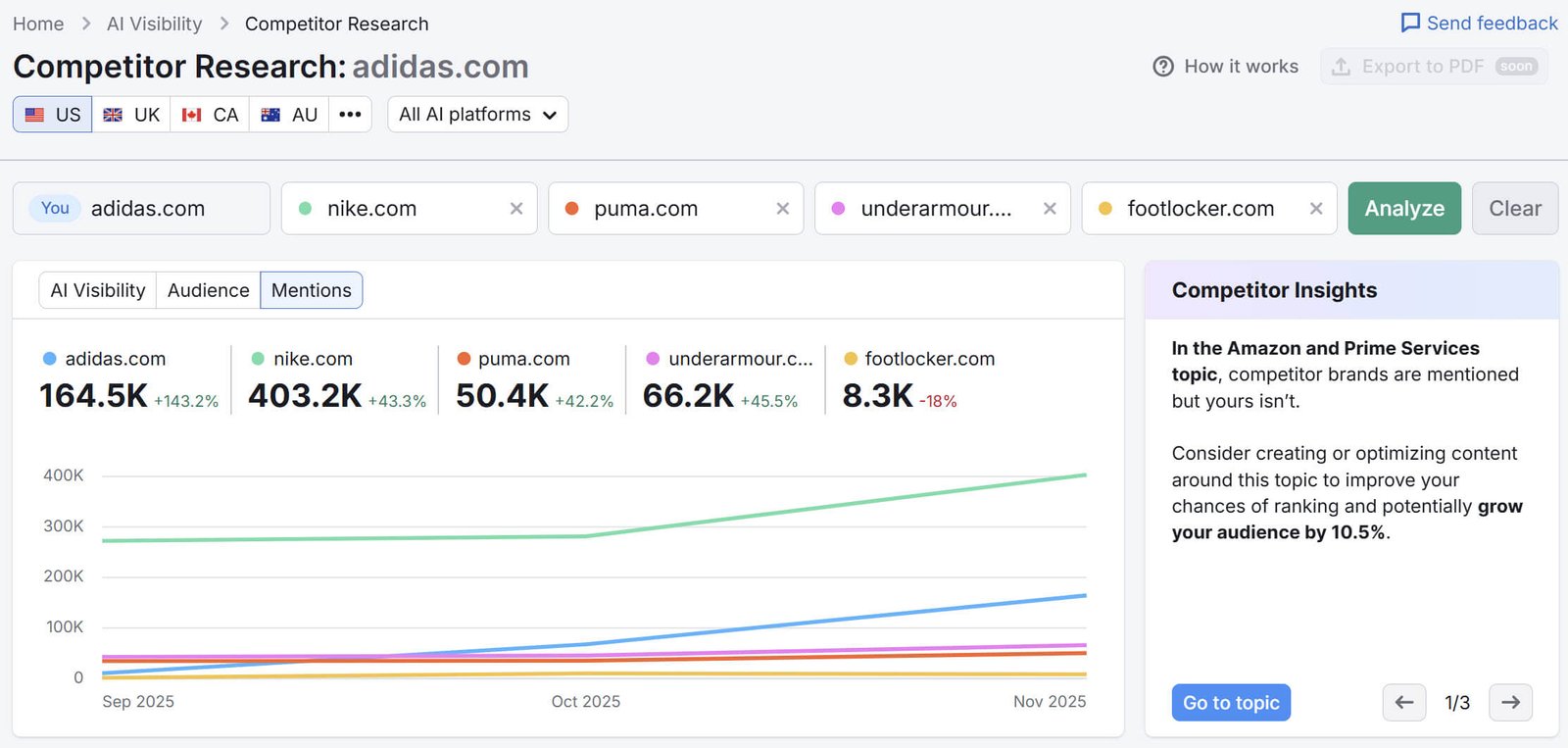
Compare your brand against up to 4 competitors.
See mention volume trends over time, identify content gaps, and understand who dominates AI conversations in your category.
Three Key Tabs:
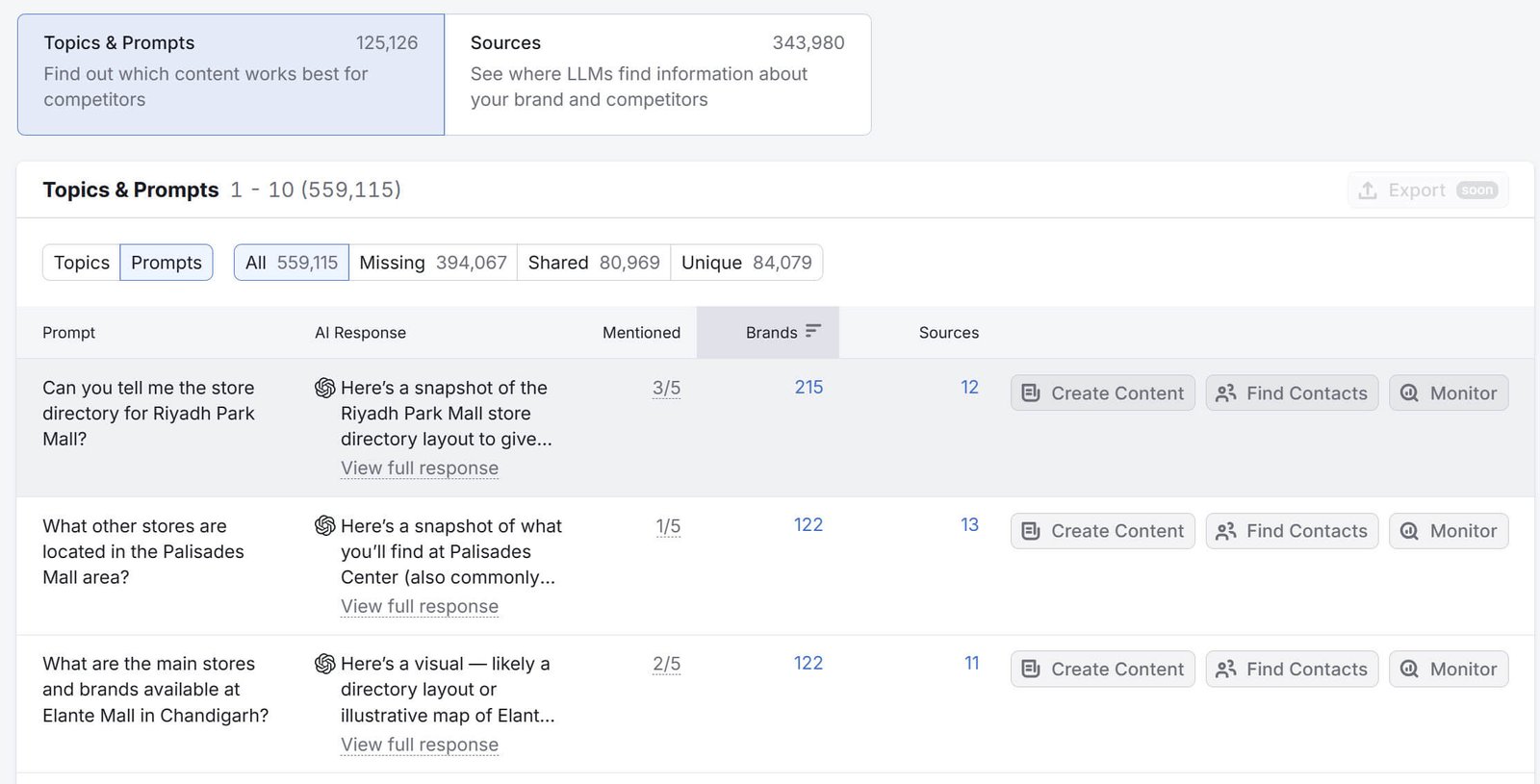
All Prompts: Complete view of where everyone appears across AI platforms
Shared: Prompts where both you and competitors appear (competitive overlap)
Missing: Prompts where competitors appear but you don’t – this is gold for content strategy
Strategic Value:
The “Missing” tab is particularly valuable. It shows specific prompts that trigger competitor mentions but where your brand doesn’t appear.
Hypothetical examples:
- “Best tools for brand voice training” – all 3 competitors appear, your brand doesn’t
- “How to create consistent content without burnout” – 2 competitors cited, you’re nowhere
These become clear content priorities. Instead of guessing what to create next, you’re seeing exactly where competitors win and you don’t.
3. Prompt Research
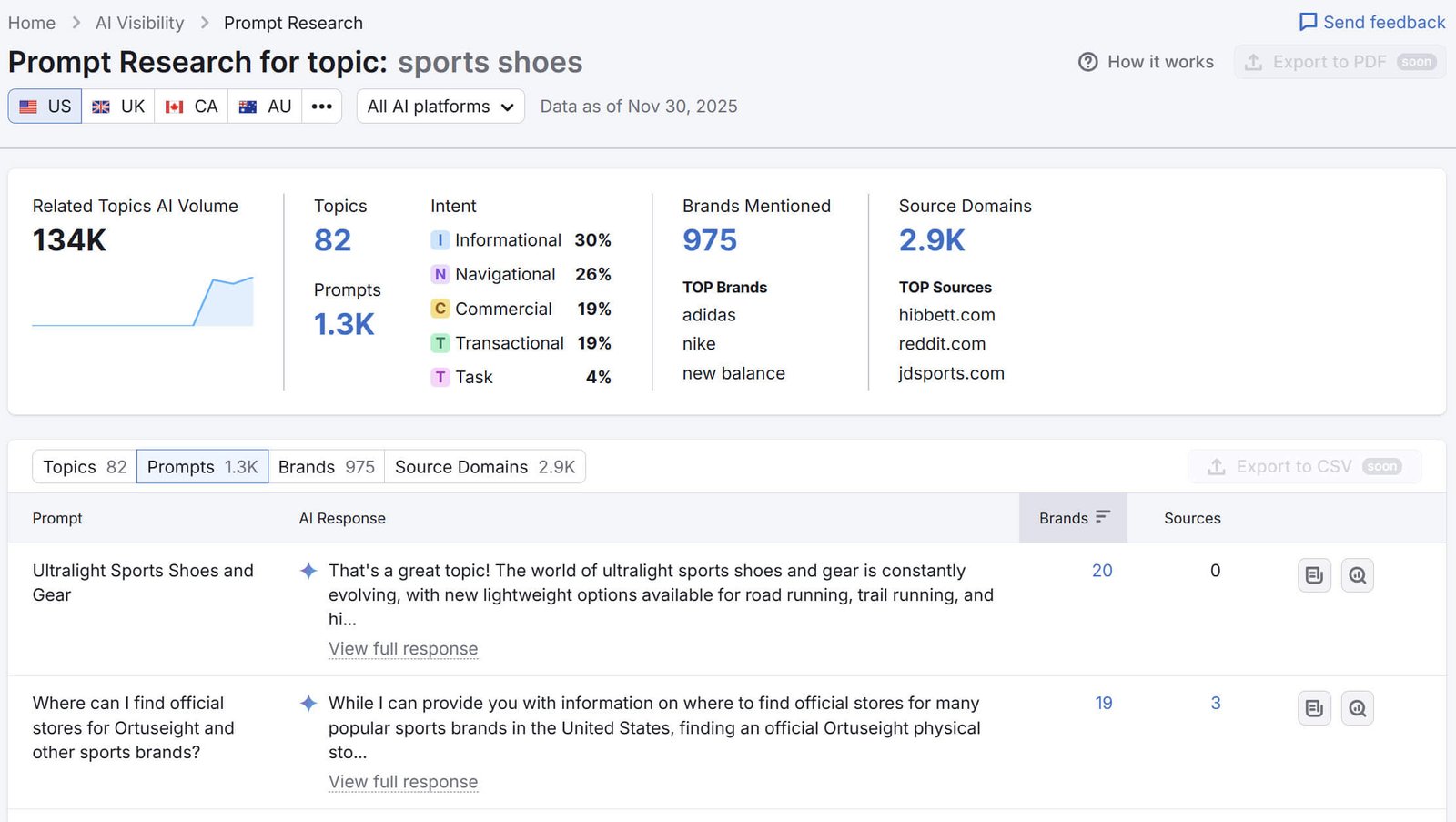
What It Shows:
Real prompts people type into AI platforms, including:
- Estimated AI search volume by topic
- Intent breakdown (informational, navigational, commercial, transactional)
- Which brands get mentioned most
- Top sources AI platforms cite
How It Works:
Search by keyword or topic and get hundreds of actual prompts. For example, searching “sports shoes” reveals 1,300+ prompts including questions like:
- “Ultralight Sports Shoes and Gear”
- “Where can I find official stores for Ortuseight and other sports brands?”
- “What are the main stores and brands available at Elante Mall in Chandigarh?”
Practical Use:
Content ideation based on actual AI search behavior, not guesswork. You see the exact questions people ask AI platforms, along with search volume and intent. This helps you create content that actually answers real queries.
Why This Matters: You’re not guessing what people ask AI – you’re seeing the actual questions. The intent breakdown helps you understand whether queries are informational (people researching) or transactional (people ready to buy), so you can create appropriate content for each stage.
4. Brand Performance (Share of Voice + Sentiment)
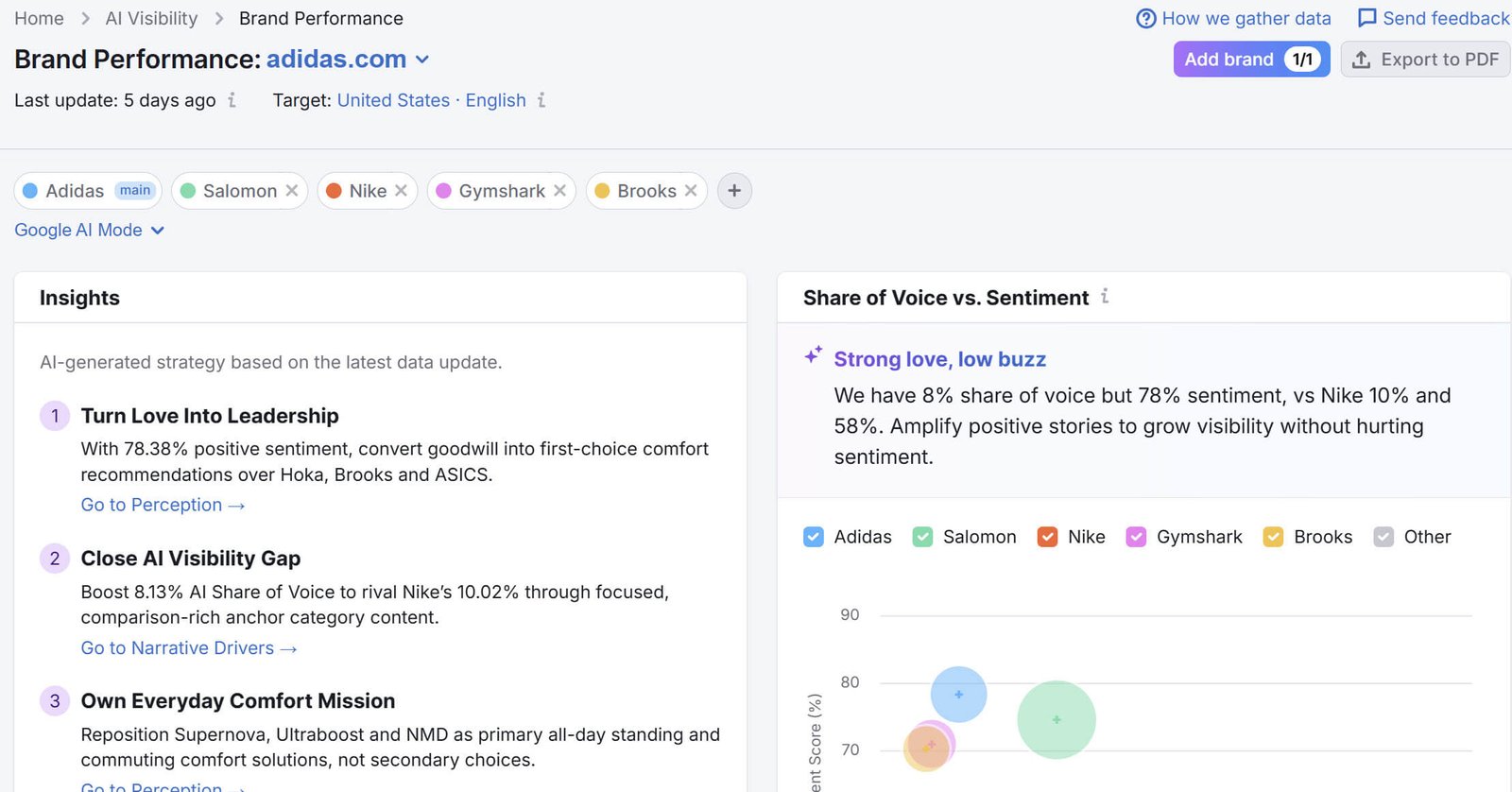
What It Shows:
- Your share of voice vs competitors across platforms
- Sentiment analysis: favorable, neutral, or negative
- Platform-by-platform comparison
Why It Matters:
High mentions with neutral sentiment means you’re just getting listed. The goal is favorable sentiment – AI describing you positively with words like “practical,” “proven,” “strategic,” or “innovative.”
What Influences Sentiment:
Including case studies, specific results, and client outcomes in your content tends to improve how AI platforms describe you. Generic content leads to neutral mentions. Detailed, results-oriented content leads to favorable sentiment.
Platform Differences:
You might win on ChatGPT but lose on Perplexity. The data shows you exactly where you’re strongest and where you need work. Different platforms weight different sources and contexts, so your presence can vary significantly.
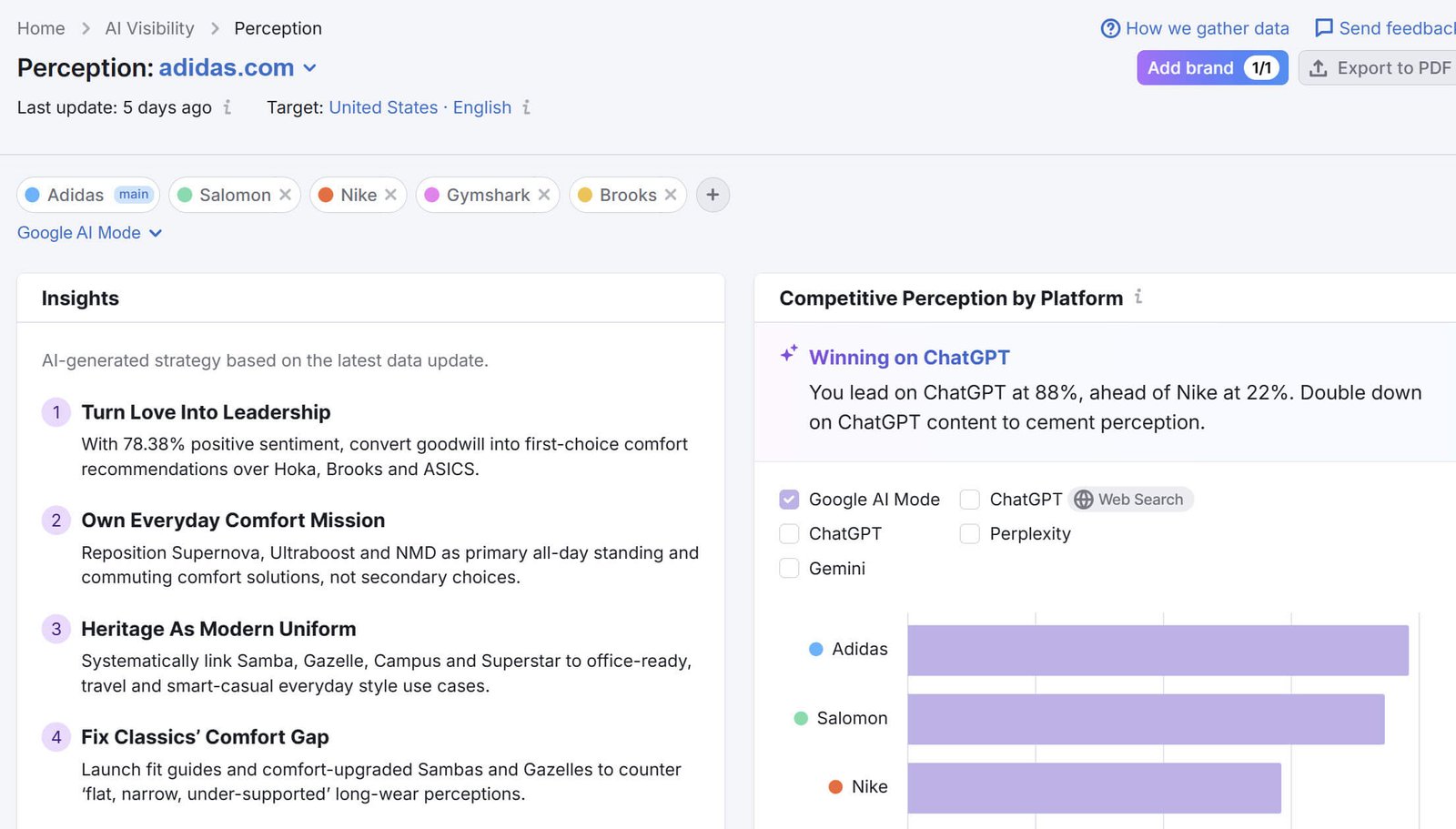
5. Perception Dashboard
What It Shows:
AI-generated strategic recommendations based on your data, such as:
- “You lead on ChatGPT at 88%, ahead of Nike at 22%. Double down on ChatGPT content to cement perception.”
- “Competitors mentioned for [topic] but you’re not – content opportunity”
The Reality:
These are directional suggestions, not step-by-step instructions. You’ll need marketing experience to interpret and apply them effectively. Semrush One points you toward opportunities – you still need to figure out exactly how to capture them.
Think of it as having a strategist highlight gaps, not having someone build your entire content plan.
6. Narrative Drivers
What It Shows:
Topics and themes associated with your brand mentions. For example, an SEO tool might be associated with “keyword research,” “competitor analysis,” and “backlink tracking.”
Practical Use:
See if AI associates you with capabilities you want to be known for. If you want to be recognized for “brand voice training” and “content automation” but those themes aren’t showing up in your narrative drivers, your content isn’t communicating that positioning effectively.
Content Strategy Implication:
This helps you identify positioning gaps. You might think your content clearly communicates what you do, but if AI platforms aren’t picking up those themes when mentioning your brand, you need to be more explicit or more consistent in your messaging.
7. Questions Tab
What It Shows:
Common questions that trigger mentions in your space. Each question represents actual user queries submitted to AI platforms.
Content Application:
Each question is a potential content piece to create. If people are asking specific questions and your competitors get mentioned in the answers but you don’t, you’ve identified exactly what content to create next.
Strategic Use:
Answer these questions better than competitors – more thoroughly, with more specific examples, with clearer structure – to increase your mention frequency.
8. Sources Analysis
What It Shows:
Which websites AI platforms cite most when mentioning brands in your category. For the “sports shoes” example, top sources included hibbett.com, reddit.com, and jdsports.com.
Strategic Use:
- Identify authoritative sources to target for coverage, guest posts, or partnerships
- Understand which content types AI platforms trust (forums, e-commerce sites, review platforms, industry publications)
- Find collaboration opportunities with high-authority sites in your space
This reveals the content ecosystem AI platforms consider credible in your industry.
9. Prompt Tracking
What It Shows:
Daily monitoring of specific high-value prompts you manually select. Track your position in AI responses for each prompt over time.
Tracking Limits by Tier:
- Starter: 25 prompts
- Pro+: 50 prompts
- Advanced: 200 prompts
How It Works:
- Select prompts relevant to your business
- Semrush tracks your position in AI responses daily
- See if you’re cited as a source
- Monitor position changes over time
Example prompts worth tracking:
- “How do I train AI to write in my brand voice”
- “Best content automation workflows for agencies”
- “How to scale content creation without burnout”
Practical Value:
Spot drops in visibility quickly and respond with updated or new content. If you drop from position 2 to position 8 for a high-value prompt, you know something changed – either competitors created better content or your content became outdated.
The AI Visibility Toolkit: Bottom Line
This is the reason to get Semrush One. If you don’t plan to actively use these features – if you’re not going to create content based on the insights, track prompts relevant to your business, or optimize for AI visibility – you’re paying for something you won’t leverage.
The data is comprehensive. The insights are strategic. But they require action.
If you’re ready to treat AI visibility as seriously as Google SEO, this toolkit gives you what you need. If you’re still focused only on traditional search, you’re paying for features you won’t use.
The SEO Toolkit: Still Solid, But Not the Main Reason to Buy
Semrush One includes 55+ traditional SEO tools. Let’s be clear about something upfront: if you only want SEO features and don’t care about AI visibility tracking yet, Semrush has other plans (like Pro or Guru) that cost less.
However – and this is important – SEO-only is becoming less relevant. Google is integrating AI Overviews into search results, and people are increasingly using AI platforms to search. Separating SEO and AI visibility doesn’t make strategic sense anymore. That’s not where the future is headed.
That said, here’s what the SEO toolkit includes:
1. Keyword Research
Database: 20+ billion keywords across global databases
Common uses:
- Finding content topics with search volume
- Understanding keyword difficulty and competition
- Identifying seasonal trends
Keyword Gap Feature:
Shows keywords competitors rank for but you don’t. This turns competitive analysis into content opportunities. For example, you might discover 47 keywords where three competitors all rank in the top 10 while your site doesn’t appear at all. Those become immediate content priorities.
2. Rank Tracking with AI Filter (THE BRIDGE FEATURE)
This is where SEO and AI visibility connect.
Standard Functionality:
Track Google rankings for your target keywords over time, see ranking changes, monitor SERP features.
THE KEY FEATURE: AI Overview Filter
You can now filter by SERP features including AI Overviews. This lets you:
- See which keywords trigger AI Overviews in Google
- Identify where you rank organically but don’t appear in the AI Overview
- Understand the gap between traditional rankings and AI visibility
Why This Matters:
You might rank #3 for “content strategy tools” on Google, but when that query triggers an AI Overview, you’re nowhere – competitors get the visibility instead. This is the exact problem Semrush One helps you spot and fix.
The Disconnect Example:
- Your page ranks #4 on Google for “best project management software”
- That keyword triggers an AI Overview 60% of the time
- When it does, your brand isn’t cited – three competitors are
- Without this data, you’d think you’re doing fine (top 5 ranking)
- With this data, you realize you’re missing significant visibility
This feature alone justifies the SEO + AI bundle approach for many businesses.
3. Site Audit
What It Does:
Crawls your site and flags technical SEO issues:
- Broken links
- Missing meta descriptions
- Duplicate content
- Page speed problems
- Mobile usability issues
- Crawl errors
- Internal linking structure
Practical Value:
Running this regularly catches things that are easy to miss manually – like accidentally blocking important pages in robots.txt or having redirect chains that slow down crawlers and hurt user experience.
It’s standard technical SEO functionality, but comprehensive and easy to use.
4. Backlink Analysis
What It Tracks:
- Total backlinks and referring domains
- New and lost backlinks
- Toxic links that could hurt your rankings
- Anchor text distribution
- Competitor backlink profiles
Practical Use:
Monitoring toxic links (spammy sites linking to you that could trigger penalties) and finding link-building opportunities by analyzing who links to competitors but not to you.
5. Content Tools
SEO Writing Assistant:
Real-time optimization suggestions as you write, including readability scores, keyword usage, and tone recommendations.
Content Analysis:
Review existing content for SEO opportunities, identify gaps, and get recommendations for improvement.
Standard content optimization tools that help you create search-friendly content without guessing.
Quick Take on the SEO Toolkit
These are solid features. Comprehensive, well-designed, and effective.
But they’re expensive if SEO-only is your goal. If you’re not planning to use the AI visibility features, you can get 80% of this functionality from cheaper alternatives like SE Ranking or Mangools.
The real value is when you use SEO + AI visibility together. That’s when the higher price point makes sense.
How It All Works Together
Here’s where Semrush One delivers strategic value that separate tools can’t match.
The Unified Dashboard Value:
You can see SEO metrics and AI visibility side by side. More importantly, you can see them SEPARATELY so you understand where the gaps are. This isn’t just convenient – it’s strategically crucial.
Example Workflow Showing Why Separate Views Matter
- You notice a drop in AI visibility for “content strategy frameworks”
- Check Position Tracking – you still rank #4 on Google for that keyword
- But when that keyword triggers an AI Overview, you’re not cited
- Check Competitor Research – see who IS cited in AI but ranks lower on Google (#7, #9)
- Analyze their content approach – what are they doing differently? More case studies? Specific frameworks named? Different content structure?
- Update your content accordingly (add concrete examples, name your frameworks explicitly, include more data points)
- Monitor both Google rankings AND AI visibility separately to measure impact
The Insight This Reveals:
- Your Google SEO strategy is working (you rank well organically)
- Your AI visibility strategy needs work (you’re not getting cited in overviews)
- These are two different problems requiring potentially different solutions
- Without separate data, you’d never spot this gap
You might need to:
- Add more structured data for AI to parse
- Include clearer headings that match common queries
- Provide more explicit answers to questions
- Add more credibility signals (data, quotes, case studies)
These changes might not significantly impact your Google ranking (you’re already #4), but they could dramatically improve your AI visibility.
Learning Curve Reality
The interface takes time to learn. 55+ SEO tools plus 9 new AI visibility features means there’s a lot to explore.
This isn’t plug-and-play. Plan for 2-3 weeks to get comfortable navigating the platform and understanding which features matter most for your specific needs.
You’ll need strategic thinking to apply insights effectively. The platform shows you data and opportunities – you still need to figure out what to do with them.
Reporting Capabilities
For Agencies:
- White-label reports you can brand as your own
- Combine SEO + AI visibility data (or show them separately)
- Client-ready presentations that demonstrate the value you’re providing
- Export capabilities for custom analysis
This is valuable for agencies who want to differentiate their service offerings with AI visibility audits and reporting.
Pricing Breakdown: What It Actually Costs
Let’s talk numbers.
Semrush One: Three Tiers
Starter: $199/month
- 1 user seat
- 25 AI prompts to track
- Basic SEO + AI visibility features
- 5 projects
Pro+: $299/month
- 1 user seat
- 50 AI prompts to track
- Enhanced tracking capacity
- 15 projects
- Additional reporting features
Advanced: $549/month
- 1 user seat
- 200 AI prompts to track
- Enterprise-level features
- 40 projects
- Advanced reporting and API access
The Bundle Savings
Here’s what makes Semrush One financially interesting:
Buying Separately:
- Semrush Pro (SEO only): $139.95/month
- AI Visibility Toolkit (standalone): $99/month
- Total if purchased separately: $238.95/month
Semrush One Starter Bundle:
- $199/month
- Saves you $39.95/month compared to buying tools separately
- $479.40 annual savings on just the Starter tier
The bundle gets more economical as you scale up to higher tiers, with increased savings on Pro+ and Advanced plans.
Important Reality About Pricing
Single User Seat:
All three tiers come with just 1 user. Additional team members cost $45-100/month per user depending on your plan.
This affects agencies and teams who need multiple people working in the tool. Budget accordingly.
Add-On Costs:
Beyond the base price, you might need:
- Extra projects if you manage multiple websites
- Additional keywords to track beyond what’s included
- More AI prompts to monitor (if 25, 50, or 200 isn’t enough)
- Additional domains for AI visibility tracking ($99/mo per domain)
Quick Price Comparison
Compared to alternatives:
- Ahrefs: $129-$1,249/month (no AI visibility tracking yet)
- Moz: $99-$599/month (no AI visibility tracking yet)
- Semrush Classic (Pro): $139.95/month (SEO only, no AI features)
- Semrush AI Visibility: $99/month standalone (AI only, limited value without SEO)
Semrush One is premium-priced, but the bundle approach saves money compared to buying SEO and AI tracking separately. To justify the cost, it needs to solve real problems for your specific business.
Test It Risk-Free
Start your exclusive 14-day free trial here (available only through this blog – the standard trial is just 7 days).
Use the trial to run specific tests: check competitor gaps, research prompts in your niche, and see if the insights are actionable for your business before committing to a paid plan.
What Semrush One Does Really Well
1. Separates Google and AI Performance
You can see exactly where each channel works and where it doesn’t. No more assuming “good SEO = good AI visibility” – you can see the actual performance differences.
This separation helps you identify specific gaps to address rather than treating visibility as one monolithic challenge.
2. Comprehensive Coverage
Currently the only major tool that unifies SEO + AI visibility tracking in one platform. You don’t need multiple subscriptions or separate logins.
Everything lives in one dashboard, which streamlines workflow and makes it easier to spot connections between traditional and AI search performance.
3. Early-Mover Advantage
AI visibility tracking launched in October 2024. This is brand new.
By using Semrush One now, you’re building data infrastructure and understanding AI visibility patterns while many competitors haven’t even started tracking this channel yet. That’s a strategic advantage.
You’re getting insights competitors may not have access to, which informs content strategy and positioning before the market becomes saturated.
4. Competitive Intelligence
You can see exactly where competitors win in AI search – not just that they’re ahead, but specifically which prompts trigger their mentions, what sentiment they earn, and how their performance differs across platforms.
The platform-by-platform comparison is particularly valuable. You might discover you dominate on ChatGPT but barely appear on Perplexity, which suggests different optimization strategies for different platforms.
5. Platform Coverage
Tracks ChatGPT, Google AI Overviews, Perplexity, and Gemini – the major AI search platforms that matter right now.
You can filter by specific platform to understand nuances in how each one treats your brand and content.
6. Agency-Ready Features
White-label reporting, comprehensive enough to be your primary tool, and the ability to differentiate services with AI visibility audits means you can spread costs across multiple clients while adding a new service offering.
If you’re an agency, this becomes a competitive differentiator when pitching clients.
7. Bundle Economics
Saves $40/month compared to buying Semrush Pro and AI Visibility Toolkit separately. The savings increase with higher tiers, making the unified platform more cost-effective than managing separate tools.
Important Limitations to Consider
1. Premium Pricing Reality
Base cost ranges from $199-549/month depending on tier. That’s a significant investment.
Additional users cost $45-100/month each, which adds up quickly for teams. Add-ons for extra projects, keywords, prompts, or domains increase the total investment further.
To justify this cost, the platform needs to solve real, measurable problems for your business. It’s not a “nice to have” at this price point.
2. Platform Coverage Gaps
Doesn’t track Claude, Grok, or Meta AI yet. As these platforms grow, coverage gaps become more noticeable.
Coverage will likely expand over time, but right now you’re not seeing the complete picture of AI visibility across all platforms.
That said, it covers the biggest platforms – ChatGPT alone drives 77% of AI search traffic – so you’re still getting visibility into the channels that matter most.
3. Strategic Recommendations Need Interpretation
The AI generates suggestions and highlights opportunities, but it doesn’t provide step-by-step action plans.
You need marketing experience to interpret what the data means and figure out exactly how to respond. This isn’t a “push button, get results” tool.
For example, if the platform tells you competitors appear for a specific prompt but you don’t, you still need to:
- Analyze what makes their content work
- Determine what angle or approach to take
- Create content that competes effectively
- Optimize for both quality and relevance
The platform points you toward opportunities. You still do the strategic thinking.
4. Single-Seat Structure
All tiers come with just 1 user seat. If your team needs collaborative access, budget $45-100 per additional user per month.
This affects workflow for agencies and in-house teams where multiple people need to access data, create reports, or manage different accounts.
5. Data Transparency Questions
How AI visibility scores are calculated isn’t fully detailed. Some metrics are estimates rather than exact counts. The methodology is evolving as AI search platforms evolve.
This is an industry-wide challenge, not just Semrush. AI platforms don’t provide perfect APIs or complete transparency about their algorithms, so any tracking tool is working with partial information.
That said, directional data is still valuable even if it’s not perfectly precise.
6. Learning Curve
55+ tools plus new AI features means there’s a lot to explore. The platform is comprehensive, which also makes it overwhelming initially.
This isn’t ideal if you want simple, focused tools that do one thing well. Semrush One is built for people who want depth and are willing to invest time learning the platform.
7. Value Depends on Current AI Visibility
If your brand barely gets mentioned in AI platforms yet, you’ll have limited immediate actionable data to work with.
The tool becomes more valuable once you have baseline visibility to improve. If you’re starting from zero AI mentions, you might need to build some presence first before the tracking features provide full value.
8. SEO-Only Alternatives Exist (But…)
Semrush Pro costs $139.95/month if you only want SEO without AI tracking.
But treating SEO and AI visibility as completely separate channels is increasingly short-sighted. AI is integrating into search everywhere. Ignoring AI visibility because “it’s too new” or “I’ll wait and see” means you’re already behind competitors who are optimizing for both channels now.
Who Should Consider Semrush One
1. Digital Marketing Agencies
Why It Works:
- Manage multiple clients (5+), so cost distributes across client base
- Can add AI visibility audits to service offerings and charge for them
- White-label reporting adds professional value to client deliverables
- Clients are starting to ask about AI search impact – you’ll have answers
Minimum Scale:
Managing at least 5 active clients makes the economics work. At that scale, you’re looking at roughly $40/month per client for comprehensive SEO + AI visibility intelligence, which is reasonable.
Competitive Advantage:
Most agencies aren’t offering AI visibility tracking yet. This differentiates your services and positions you as forward-thinking.
2. In-House Marketing Teams (Mid-to-Large Brands)
Why It Works:
- You’re managing significant traffic and visibility across multiple channels
- AI recommendations are starting to impact discovery in your category
- You have budget for comprehensive tools that solve multiple problems
- Your team can leverage the depth of features across different initiatives
- You need to understand how Google and AI performance differ to allocate resources effectively
When It Makes Sense:
You already have measurable AI visibility to track and improve. If brand mentions exist but aren’t optimized, this tool helps you understand patterns and improve systematically.
3. Advanced SEO Professionals
Why It Works:
- You’re treating SEO + AI visibility as a unified visibility problem, not separate channels
- You want comprehensive data in one platform without juggling multiple tools
- Client work or consulting justifies the investment financially
- You’re comfortable with complex tools and can extract value independently
- Early adopter positioning gives you expertise that sets you apart
Key Factor:
You can apply strategic insights without hand-holding. You understand how to translate data into action plans and content strategies.
4. Brands Where AI Search Is Already Impacting Discovery
Why It Works:
- Your customers are provably using ChatGPT/Perplexity to research products or services in your space
- Competitors are appearing in AI results and capturing attention you’re missing
- You need to understand and close specific visibility gaps that are costing you opportunities
- Ignoring this channel isn’t an option anymore – it’s affecting your business
Reality Check:
If you can tie business impact to AI visibility (lost leads, competitor wins, changed customer behavior), the investment makes sense. If AI visibility is still theoretical for your business, it might be too early.
When Semrush One May Not Fit
1. Solo Creators / Small Businesses
Why It May Not Fit:
- Premium pricing ($199+/month) vs budget constraints
- Feature depth exceeds immediate needs – you’d be paying for tools you don’t use
- Simpler, more focused tools can cover core SEO requirements for less money
- ROI timeline is unclear at your current revenue level
Better Alternative:
Start with budget-friendly SEO tools (like SE Ranking at $49/month or Ubersuggest at $29/month), manually check AI visibility for now, and upgrade to Semrush One when monthly revenue comfortably supports $199+ investment.
Revisit When:
Your business generates enough monthly revenue that $199-299/month is 2% or less of monthly income, and you’ve confirmed customers in your niche actually use AI search.
2. Local Service Businesses
Why It May Not Fit:
- AI Overviews may not significantly impact local service discovery yet (people still search “plumber near me” traditionally)
- Local SEO tools are more targeted for geographic visibility
- Your customers primarily find you through Google Maps, local directories, and traditional search
- Geographic focus limits how much AI search relevance matters currently
Better Alternative:
Specialized local SEO platforms like BrightLocal or Whitespark that focus specifically on local search, Google Business Profile optimization, and local citations.
Revisit When:
You notice customers specifically mentioning they found competitors via AI search, or AI platforms start significantly featuring local businesses in answers to geographic queries.
3. Very Early Stage Brands
Why It May Not Fit:
- No existing AI visibility to track yet means limited actionable data
- Your content footprint is too small for meaningful mentions
- Better to invest in creating quality content first, then optimize once you have baseline presence
- The tracking features don’t help much when you’re starting from zero
Better Alternative:
Focus resources on creating great content, building domain authority, and establishing your expertise. Check back in 6-12 months once you have measurable visibility to optimize.
4. Teams Not Ready to Act on Insights
Why It May Not Fit:
- Data is only valuable if you actually use it to change your content strategy
- No capacity to create new content based on insights
- Just want to “monitor” without taking strategic action
- Buying expensive tools that won’t be leveraged is wasted money
Better Alternative:
Wait until you have dedicated resources (time, budget, team capacity) to actually implement recommendations. Don’t buy the tool “just to have it.”
Decision Framework: Is Semrush One Right for You?
Key Questions to Ask Yourself
1. Do I have an AI visibility problem to solve?
- Are people in your industry actively using AI search for research?
- Are competitors appearing in AI results where you’re not?
- Would improving AI visibility meaningfully impact your business growth?
- Can you afford to ignore this channel while competitors optimize for it?
2. Do I need to see Google and AI data separately?
- Do you suspect your performance differs significantly across channels?
- Would knowing exactly where gaps exist help you develop better strategies?
- Are you ready to potentially run different content approaches for each channel?
3. Can I justify $199-549/month?
- Against current monthly revenue?
- Spread across multiple clients (if you’re an agency)?
- As a strategic marketing investment that pays for itself?
- Compared to the cost of losing visibility in AI search while competitors gain it?
4. Will I actually use the AI visibility features?
- Or are you paying for features without planning to apply insights?
- Do you have capacity to create content based on recommendations?
- Can you dedicate time to analyzing data and adjusting strategy?
5. Do I need this level of tool depth?
- Or would simpler, more focused solutions work for now?
- Are you ready for 55+ tools plus new AI features?
- Do you have time (2-3 weeks) to learn the platform properly?
6. Is my team structure compatible?
- Is a single user seat sufficient for your workflow?
- Or will you need multiple seats, increasing total cost significantly?
- How does this fit into your existing tool ecosystem?
Scenarios Where It Makes Sense
✅ Agency managing diverse client portfolio – with AI visibility questions becoming common and the ability to charge for these insights
✅ Brand with established presence – wanting to understand and systematically optimize AI visibility before competitors do
✅ Advanced SEO professional – treating unified search visibility as a competitive advantage worth investing in early
✅ Team that will actually act – on separate Google + AI intelligence rather than just passively monitoring data
✅ Business where customers provably use AI – for research in your category, making this channel materially important
Scenarios Where It Doesn’t Make Sense Yet
❌ Just starting out – with limited budget where every dollar needs immediate, measurable ROI
❌ No evidence of AI search impact – in your niche yet, making this investment premature
❌ Solo creator without clear ROI path – who needs simpler tools that match current business scale
❌ Want simple, focused tools – rather than comprehensive platforms with extensive features
❌ Not ready to invest learning time – in a complex system that requires strategic thinking to use well
The 14-Day Trial Strategy
Get your exclusive 14-day free trial here (only available through this blog – standard trial is 7 days).
Use it strategically:
Don’t try to learn everything. Focus on answering specific questions:
Week 1: Assessment
- Run competitor research – do you find actionable gaps where they appear but you don’t?
- Check prompt research – are people asking questions in your space that you could answer better?
- Look at your visibility across platforms – are there meaningful differences between ChatGPT, Perplexity, and Google AI?
- Review the perception dashboard – do strategic recommendations make sense for your business?
Week 2: Application Test
- Pick ONE insight from Week 1
- Create or update content based on that insight
- See if implementing recommendations feels natural or forced
- Evaluate: “Would I consistently do this work if I paid $199/month?”
Key Question to Answer:
“Is this worth $199+/month based on what I’m seeing, or should I revisit in 6 months?”
Be honest with yourself. If insights feel interesting but you’re not sure you’d act on them, that’s a signal to wait.
Final Verdict: Who Wins With Semrush One?
What Semrush One Actually Is
The first major platform to unify traditional SEO and AI visibility tracking in a meaningful way. It’s built for agencies, established brands, and advanced practitioners who need intelligence on both Google and AI search performance.
It’s designed for people who understand that data alone isn’t valuable – action on insights is what matters.
What It’s Not
Not a budget-friendly entry tool for beginners. Not a simple plug-and-play solution that does the thinking for you. Not necessary for every single business regardless of size or stage.
And definitely not “just SEO tools with AI features tacked on” – the integration between traditional and AI visibility tracking creates strategic value that neither channel alone provides.
The Core Value Proposition
You can finally see how your Google performance and AI visibility differ, understand why those gaps exist, and develop distinct strategies to improve both channels.
This matters because treating SEO and AI visibility as the same problem doesn’t work. Different platforms prioritize different signals, cite different sources, and serve different user intents.
My Recommendation by Audience
For Agencies:
Strategic investment if you’re managing 5+ clients and can add AI visibility audits to differentiate your services. Cost justifies when spread across your client base, and you can charge for this new capability.
For In-House Marketing Teams:
Solid choice if you’re at a mid-to-large brand where AI search is measurably impacting your category and you need unified visibility intelligence to make smart resource allocation decisions.
For Solo Creators/Small Businesses:
Wait until monthly revenue comfortably supports $199+ investment AND you have evidence that AI search actually matters in your niche. Don’t buy tools you’re not ready to use strategically.
For Local Businesses:
Evaluate whether AI search significantly impacts local discovery in your specific market. If customers still find you primarily through traditional local search and Google Maps, specialized local tools may serve you better for now.
The Real Question
Not “Is Semrush One good?” but rather: “Do I need to understand and optimize both Google and AI visibility right now, and will I actually act on those insights?”
For Many Businesses:
The answer is “Yes, absolutely” – especially if competitors are already winning in AI search and you’re losing opportunities you can’t even see.
For Others:
The answer is “Not yet – but revisit in 6-12 months” – especially if you’re building baseline presence first or waiting for clearer AI search adoption in your market.
Both Answers Are Completely Valid
It depends entirely on where you are in your growth journey, what challenges you’re actively solving, and whether customers in your space are demonstrably using AI search for discovery.
The Bottom Line
AI search isn’t replacing Google tomorrow. But the trajectory is clear:
- 77% of Americans now use ChatGPT as a search engine
- AI traffic grew 7x from 2024 to 2025
- Google itself is integrating AI Overviews into traditional search results
If you’re serious about long-term visibility, treating SEO and AI as separate problems won’t work. The channels are converging, not diverging.
Semrush One lets you see both channels clearly, understand the differences strategically, and act intelligently.
Whether you need it right now depends on your specific situation. But pretending AI search doesn’t matter? That’s not a strategy that ages well.
Ready to explore for yourself? Start your exclusive 14-day free trial (only available through this blog) and run the tests outlined in this review. The extended trial gives you full access to test AI visibility tracking, competitive research, and prompt analysis – everything you need to determine if this solves real problems for your business.